Int J Stomatol ›› 2026, Vol. 53 ›› Issue (2): 197-204.doi: 10.7518/gjkq.2026217

• Original Articles • Previous Articles    

Effect of yttria doping content on the optical properties of dental zirconia

Linfeng He(),Fei Liu,Jiefei Shen()   

  1. State Key Laboratory of Oral Diseases & National Center for Stomatology & National Clinical Research Center for Oral Diseases & Dept. of Prosthodontics II, West China Hospital of Stomatology, Sichuan University, Chengdu 610041, Si-chuan, China
  • Received:2024-12-04 Revised:2025-05-28 Online:2026-03-01 Published:2026-02-13
  • Contact: Jiefei Shen E-mail:1151904889@qq.com;shenjiefei@scu.edu.cn
  • Supported by:
    National Key Research and Development Program of China(2022YFC2410102)

Abstract:

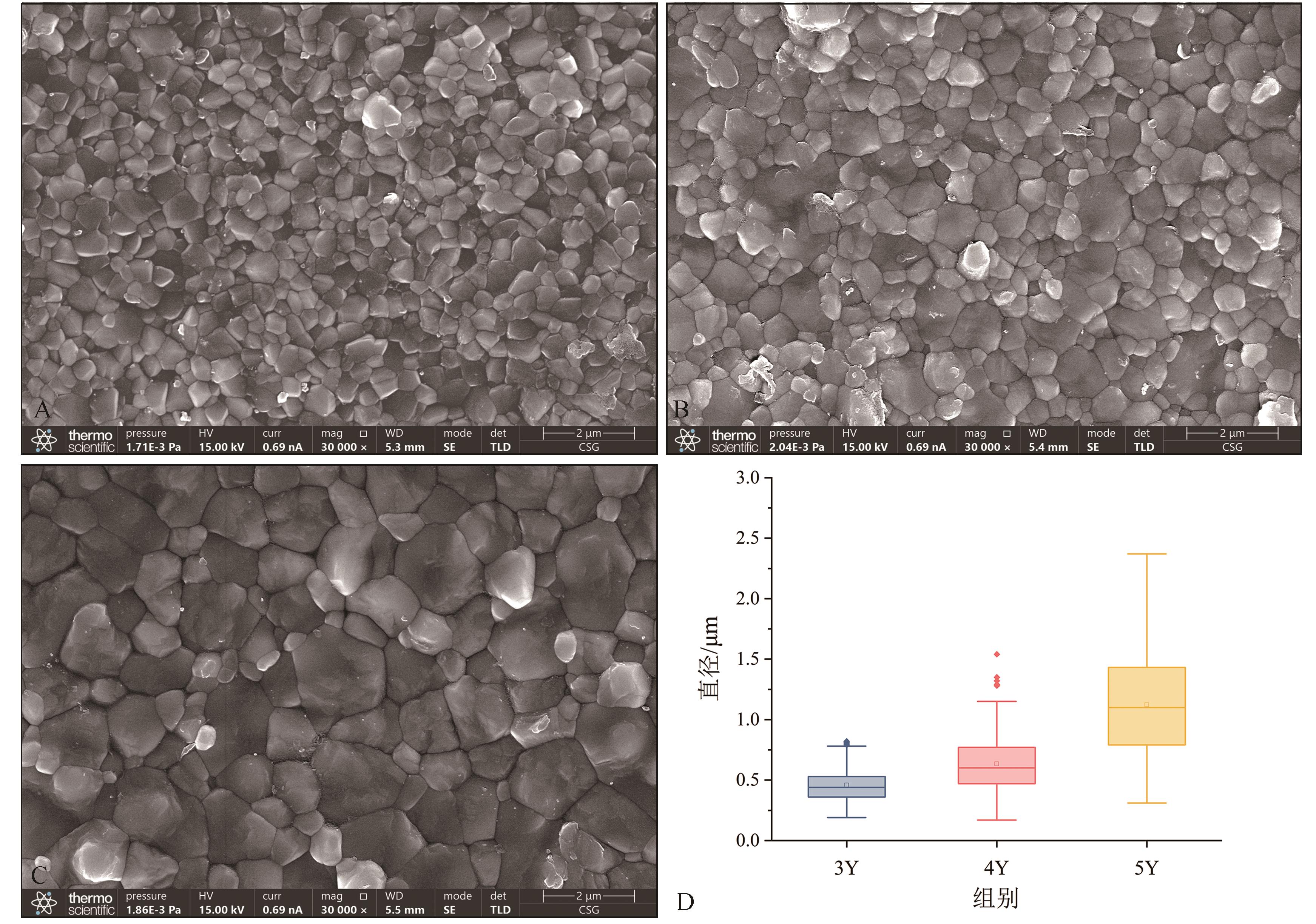
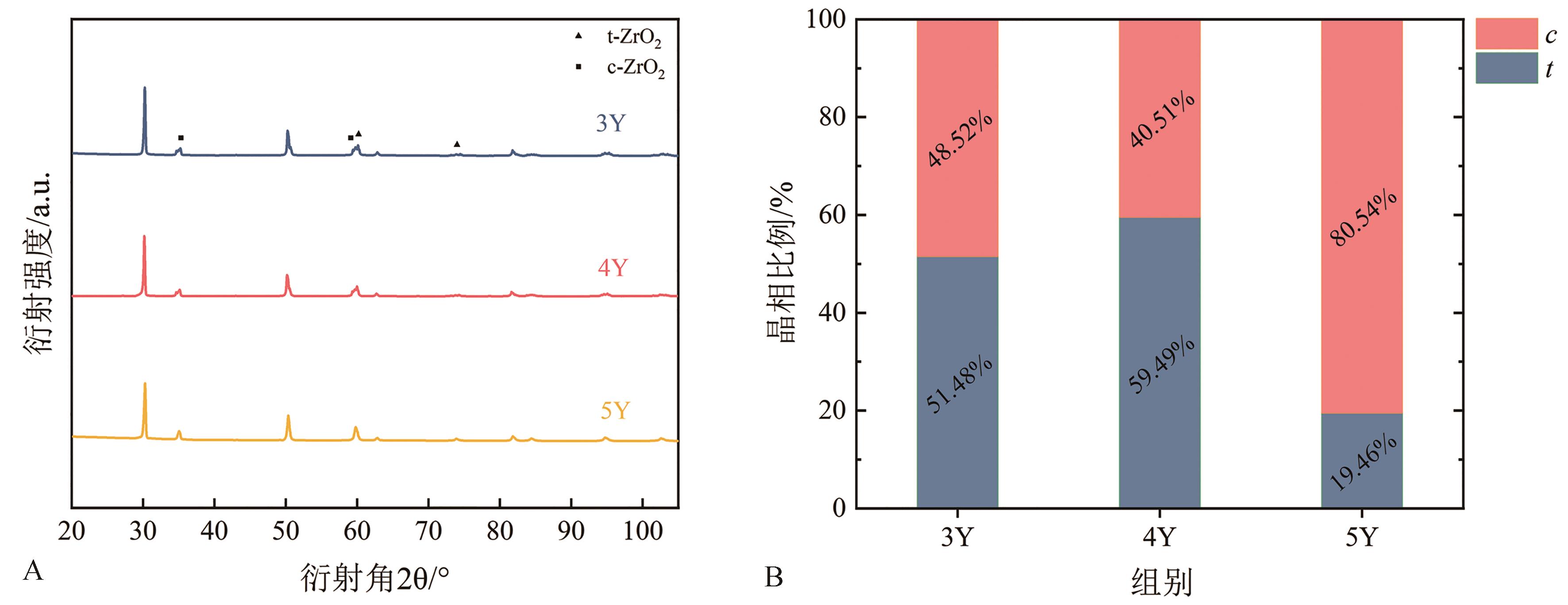
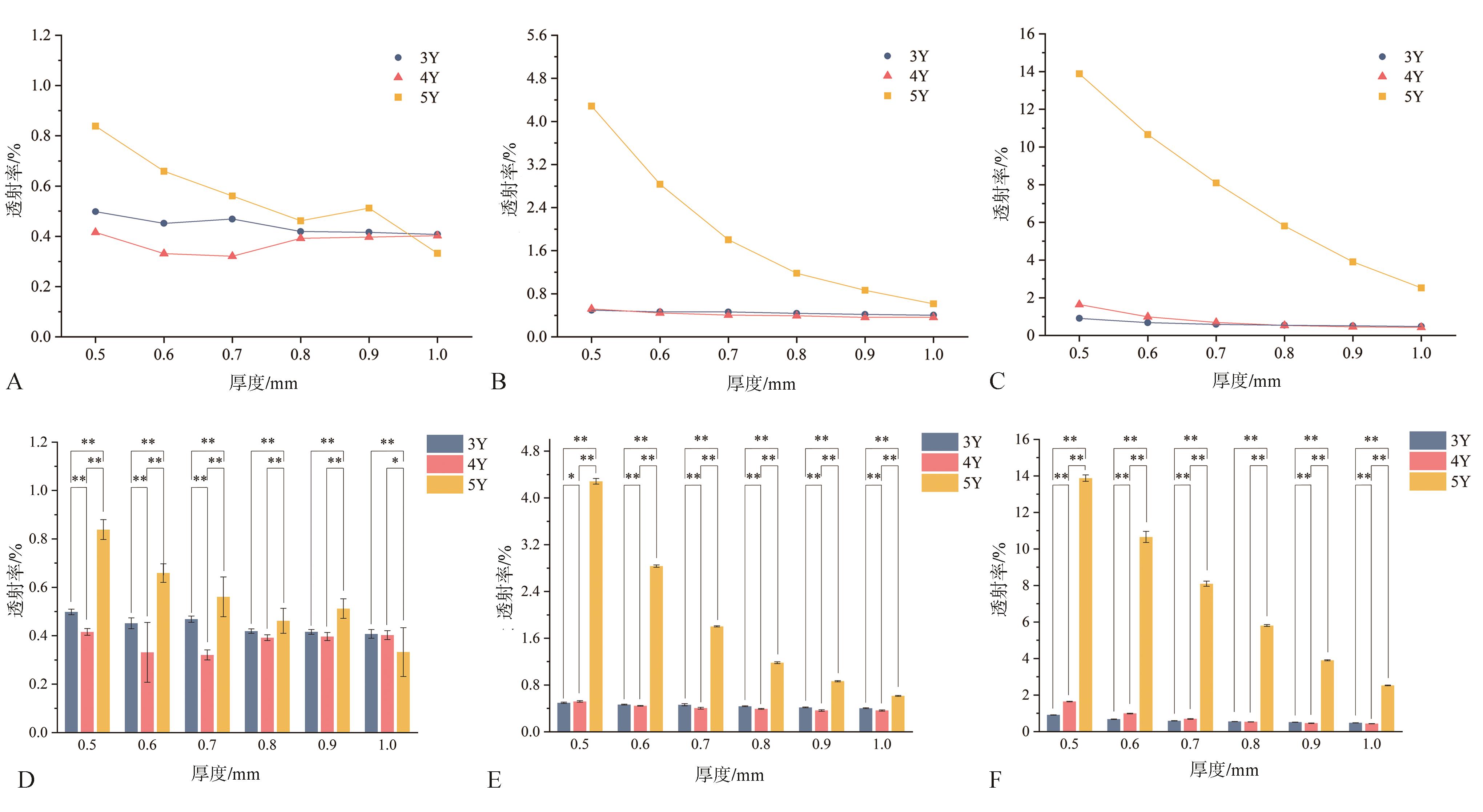
Objective This study aims to investigate the effect of yttria doping content on the microstructural changes and optical properties of zirconia. Methods Zirconia materials from the same brand, with yttria additions of 3 mol% (3Y), 4 mol% (4Y), and 5 mol% (5Y), were employed. Presintered discs were prepared, and sample specifications were designed, cut, and densified accordingly. For microstructural characterization, ceramic samples were sintered into circular discs with a diameter of 9 mm and a thickness of 2 mm. For optical performance characterization, ceramic samples were sintered into square plates measuring 6 mm× 8 mm, with thicknesses ranging from 0.5-1.0 mm in equal intervals. A total of 6 groups (n=5) were prepared. Surface morphology was examined using scanning electron microscopy, and the crystal phase proportion was refined via X-ray diffraction. The refractive index was measured with an ellipsometer, and transmittance and the contrast ratio (CR) were evaluated using a spectrophotometer. Results Increasing the yttria doping level resulted in enlarged crystal diameters. Among the groups, 4Y exhibited the largest tetragonal phase proportion (59.49%), and 5Y had the smallest (19.46%). The refractive index decreased with increased yttria doping. Transmittance was substantially influenced by wavelength and material thickness, with long wavelengths (705 nm) achieving the highest transmittance and short wavelengths (435 nm) having the lowest for all materials. The transmittance values of the 3Y and 4Y groups were below 1%. The transmittance of the 5Y group exceeded 10% at long wavelengths (705 nm) and was below 1% at short wavelengths (435 nm). The CR values were minimally affected by thickness. The 3Y and 4Y groups had average CR values of 0.8±0.1, and statistical differences were observed only between select groups. The 5Y group had an average CR value of 0.4±0.2, which was statistically significantly different from those of the other groups. Conclusion Low yttria doping levels promoted the growth of tetragonal-phase crystals, and high yttria levels significantly enhanced the formation of cubic-phase crystals. A doping level of 5 mol% yttria is necessary to effectively improve the translucency of zirconia.

Key words: zirconia, yttria, tetragonal phase, cubic phase, optical property, refractive index, translucency

CLC Number: 

  • R783.1

TrendMD: 

Tab 1

Physical and chemical properties of zirconia ceramics with different yttria contents after pre-sintering and final sintering"

物理化学参数3Y4Y5Y
氧化钇添加量3 mol%4 mol%5 mol%
预烧结后密度/(g/cm3≥2.80≥2.80≥2.80
预烧结后化学溶解性/(μg/cm2≤100≤100≤100
终烧结收缩率/%19~2219~2219~22
终烧结后密度/(g/cm3≥6.0≥6.0≥6.0
终烧结后化学溶解性/(μg/cm2≤2 000≤ 2 000≤ 2 000
终烧结后维氏硬度/GPa≥12.5≥12.5≥12.5
终烧结后挠曲强度/MPa>900≥900≥500

Tab 2

Sintering process of zirconia ceramics with varied doping ratios"

组别烧结阶段升温速率/(℃/min)目标温度/℃升温时间/min保温时间/min总时间/min时间进度/min
3Y起始阶段-20--00
第一阶段109008820108108
第二阶段51 530126120246354
退火阶段-10300123-123477
4Y起始阶段-20--00
第一阶段121 10090-9090
第二阶段1.21 40025010260350
第三阶段21 50050120170520
退火阶段-9300134-134654
5Y起始阶段-20--00
第一阶段121 10090-90904
第二阶段1.21 40025010260350
第三阶段1.61 48050120170520
退火阶段-8.390070-70590

Fig 1

Surface morphology images and crystal diameter statistics of three groups of YSZ ceramics SEM × 30 000"

Fig 2

XRD patterns (A) and crystal phase ratio diagrams (B) of three groups of YSZ ceramics"

Tab 3

Refractive index of three groups of YSZ ceramics"

组别B值C值D值MSE值
3Y2.167 000 00±0.000 616 690.024 860 00±0.000 426 42-0.000 894 800±0.000 058 5340.996
4Y2.155 000 00±0.000 470 790.022 470 00±0.000 325 58-0.000 445 980±0.000 044 7110.768
5Y2.145 000 00±0.000 415 520.019 400 00±0.000 287 27-0.000 168 870±0.000 027 3590.683

Fig 3

Line charts (A, B, C) and statistical plots (D, E, F) of transmittance for three groups of YSZ ceramics at different wavelengths"

Fig 4

Line charts (A, B, C) and statistical plots (D, E, F) of translucency for three groups of YSZ ceramics at different wavelengths"

[1] Denry I, Kelly JR. State of the art of zirconia for dental applications[J]. Dent Mater, 2008, 24(3): 299-307.
[2] Han MK. Advances and challenges in zirconia-based materials for dental applications[J]. J Korean Ceram Soc, 2024, 61(5): 783-799.
[3] Uasuwan P, Juntavee N, Juntavee A. Flexural strength of novel glass infiltrated monochrome and multilayer high yttrium oxide containing zirconia upon various sintered cooling rates[J]. J Prosthodont, 2024, 33(S1): 47-59.
[4] Reale Reyes A, Dennison JB, Powers JM, et al. Translucency and flexural strength of translucent zirconia ceramics[J]. J Prosthet Dent, 2023, 129(4): 644-649.
[5] Mao L, Kaizer MR, Zhao M, et al. Graded ultra-translucent zirconia (5Y-PSZ) for strength and functionalities[J]. J Dent Res, 2018, 97(11): 1222-1228.
[6] Zhang F, Inokoshi M, Batuk M, et al. Strength, toughness and aging stability of highly-translucent Y-TZP ceramics for dental restorations[J]. Dent Mater, 2016, 32(12): e327-e337.
[7] Zhang Y, Lawn BR. Novel zirconia materials in dentistry[J]. J Dent Res, 2018, 97(2): 140-147.
[8] 万乾炳. 口腔氧化锆修复材料分代之我见[J]. 国际口腔医学杂志, 2021, 48(2): 125-128.
Wan QB. My opinion on the generations of dental zirconia materials[J]. Int J Stomatol, 2021, 48(2): 125-128.
[9] Wang L, Wang K, Sheng Y, et al. The effect of phase contents on the properties of yttria stabilized zirconia dental materials fabricated by stereolitho-graphy-based additive manufacturing[J]. J Mech Behav Biomed Mater, 2024, 150: 106313.
[10] Pabst W, Hostaša J. A closed-form expression approximating the mie solution for the real-in-line transmission of ceramics with spherical inclusions or pores[J]. Ceramics-Silikáty, 2013, 57(2): 151-161.
[11] Pabst W, Hříbalová S. Light scattering models for describing the transmittance of transparent and translucent alumina and zirconia ceramics[J]. J Eur Ceram Soc, 2021, 41(3): 2058-2075.
[12] Jiang L, Liao YM, Wan QB, et al. Effects of sinte-ring temperature and particle size on the translucency of zirconium dioxide dental ceramic[J]. J Mater Sci Mater Med, 2011, 22(11): 2429-2435.
[13] Sen N, Sermet IB, Cinar S. Effect of coloring and sintering on the translucency and biaxial strength of monolithic zirconia[J]. J Prosthet Dent, 2018, 119(2): 308.e1-308.e7.
[14] Zhang F, Vanmeensel K, Batuk M, et al. Highly-translucent, strong and aging-resistant 3Y-TZP ceramics for dental restoration by grain boundary se-gregation[J]. Acta Biomater, 2015, 16: 215-222.
[15] Vult von Steyern P, Bruzell E, Vos L, et al. Sintering temperature accuracy and its effect on translucent yttria-stabilized zirconia: flexural strength, crystal structure, tetragonality and light transmission[J]. Dent Mater, 2022, 38(7): 1099-1107.
[16] Miyagawa Y, Powers JM, O’Brien WJ. Optical pro-perties of direct restorative materials[J]. J Dent Res, 1981, 60(5): 890-894.
[17] Alshahrani AM, Lim CH, Wolff MS, et al. Current speed sintering and high-speed sintering protocols compromise the translucency but not strength of yttria-stabilized zirconia[J]. Dent Mater, 2024, 40(4): 664-673.
[18] Elsaka SE. Optical and mechanical properties of newly developed monolithic multilayer zirconia[J]. J Prosthodont, 2019, 28(1): e279-e284.
[19] Shahmiri R, Standard OC, Hart JN, et al. Optical properties of zirconia ceramics for esthetic dental restorations: a systematic review[J]. J Prosthet Dent, 2018, 119(1): 36-46.
[20] Vasylkiv O, Sakka Y, Skorokhod VV. Hardness and fracture toughness of alumina-doped tetragonal zirconia with different yttria contents[J]. Mater Trans, 2003, 44(10): 2235-2238.
[21] Doğru G, Yılmaz H. Influence of low-temperature degradation on phase transformation and biaxial flexural strength on different high-translucent 4Y-PSZ, 5Y-PSZ, 6Y-PSZ monolithic zirconia[J]. Clin Exp Health Sci, 2024, 14(1): 45-53.
[22] Hříbalová S, Pabst W. Modeling light scattering by spherical pores for calculating the transmittance of transparent ceramics-All you need to know[J]. J Eur Ceram Soc, 2021, 41(4): 2169-2192.
[23] Ebeid K, Wille S, Hamdy A, et al. Effect of changes in sintering parameters on monolithic translucent zirconia[J]. Dent Mater, 2014, 30(12): e419-e424.
[24] Kim MJ, Ahn JS, Kim JH, et al. Effects of the sinte-ring conditions of dental zirconia ceramics on the grain size and translucency[J]. J Adv Prosthodont, 2013, 5(2): 161-166.
[25] Tuncel İ, Turp I, Üşümez A. Evaluation of translucency of monolithic zirconia and framework zirconia materials[J]. J Adv Prosthodont, 2016, 8(3): 181-186.
[26] Ban S. Reliability and properties of core materials for all-ceramic dental restorations[J]. Jpn Dent Sci Rev, 2008, 44(1): 3-21.
[27] Zhang Y. Making yttria-stabilized tetragonal zirconia translucent[J]. Dent Mater, 2014, 30(10): 1195-1203.
[28] Hammoudeh H, Carracho L, Beard C, et al. Effect of different surface and heat treatments on the surface roughness, crystallography, and phase composition of high translucency zirconia for monolithic restorations[J]. J Prosthet Dent, 2024, 131(1): 164.e1-164.e11.
[1] Jie Yu, Jinsong Liu. Surface modification of zirconia implants to promote bone integration [J]. Int J Stomatol, 2025, 52(3): 281-295.
[2] Bo Huang,Jian Wang,Xin Zhang. Zirconia ceramics in dental restoration: evaluation and solutions for low-temperature degradation [J]. Int J Stomatol, 2025, 52(2): 169-175.
[3] Xuemin Yao,Hua Wang,Lu Wang,Bin Zhao. Factors influencing the bonding effect of oral translucent zirconia ceramics [J]. Int J Stomatol, 2024, 51(4): 450-455.
[4] Wang Xiao-chen,Wang Jian.. Research progress on preparation forms for the margin of monolithic zirconia crowns in posterior teeth [J]. Int J Stomatol, 2023, 50(4): 485-490.
[5] Zeng Fang,Wang Jian. Influencing factors of aesthetic prosthesis performance of monolithic zirconia crowns [J]. Int J Stomatol, 2022, 49(2): 233-238.
[6] Yang Guangmei,Wang Jian. Mechanical properties of monolithic zirconia crowns and its relationship with clinical application [J]. Int J Stomatol, 2022, 49(1): 79-84.
[7] Li Min,Hua Chengge,Jiang Li. Research progress on new technology for improving adhesion properties of zirconia ceramics [J]. Int J Stomatol, 2021, 48(4): 485-490.
[8] Wan Qianbing. My opinion on the generations of dental zirconia materials [J]. Int J Stomatol, 2021, 48(2): 125-128.
[9] Wan Qianbing. Research status and clinical outcomes of zirconia abutments [J]. Inter J Stomatol, 2018, 45(1): 1-8.
[10] Wan Qianbing. Several problems on monolithic zirconia crowns [J]. Inter J Stomatol, 2018, 45(1): 9-13.
[11] Zhang Yarong, Liu Yang, Zhang Ling, Yu Haiyang. Quantitative analysis of the load tolerance of maxillary incisors with ceramic-laminated veneers for various incisal margin preparations [J]. Inter J Stomatol, 2017, 44(3): 301-303.
[12] Yao Chenmin, Zhou Liqun, Huang Cui.. Selection of tooth-colored restorative material for worn anterior teeth [J]. Inter J Stomatol, 2017, 44(3): 363-367.
[13] Chen Jifen, Ding Hong. Effect of polishing and glazing techniques on the wearing of zirconia crown against enamel [J]. Inter J Stomatol, 2016, 43(2): 165-167.
[14] Lin Jie1, Zheng Zhifeng2, Lu Zhaojie1, Li Xiurong2, Zheng Zhiqiang1.. Design and bonding technique of posterior zirconia resin-bonded fixed partial dentures [J]. Inter J Stomatol, 2015, 42(6): 624-627.
[15] Wang Wanwei, Chen Yuanhua, Yu Qing. Relationship between colorimetry and transparency of zirconia ceramic with clinical all-ceramic crown repair [J]. Inter J Stomatol, 2015, 42(3): 302-305.
Viewed
Full text


Abstract

Cited

  Shared   
  Discussed   
No Suggested Reading articles found!