Int J Stomatol ›› 2026, Vol. 53 ›› Issue (3): 328-334.doi: 10.7518/gjkq.2026218

• Digitization • Previous Articles    

Application of convolutional neural networks ResNet-101 and Inception-v3 for detecting three-rooted mandibular first molars in panoramic radiographs

Wenyuan Zhou1(),Juan Fan1,Zaidao Xiong1,Lin Zhu1,Zezheng Yu1,Lu Wang1,Long Jin2,Panpan Zhang3,Yongchun Gu1()   

  1. 1.Dept. of Dentistry and Central Lab, Ninth People’s Hospital of Suzhou, Soochow University, Suzhou 215200, China
    2.Dept. of Radiology, Ninth People’s Hospital of Suzhou, Soochow University, Suzhou 215200, China
    3.Dept. of Otorhinolaryngology, Ninth People’s Hospital of Suzhou, Soochow University, Suzhou 215200, China
  • Received:2024-12-04 Revised:2025-10-30 Online:2026-05-01 Published:2026-04-24
  • Contact: Yongchun Gu E-mail:zhouwenyuan_zwy@163.com;guyc7152@163.com
  • Supported by:
    Medical Health Science and Technology Innovation Project(SKY2022030)

Abstract:

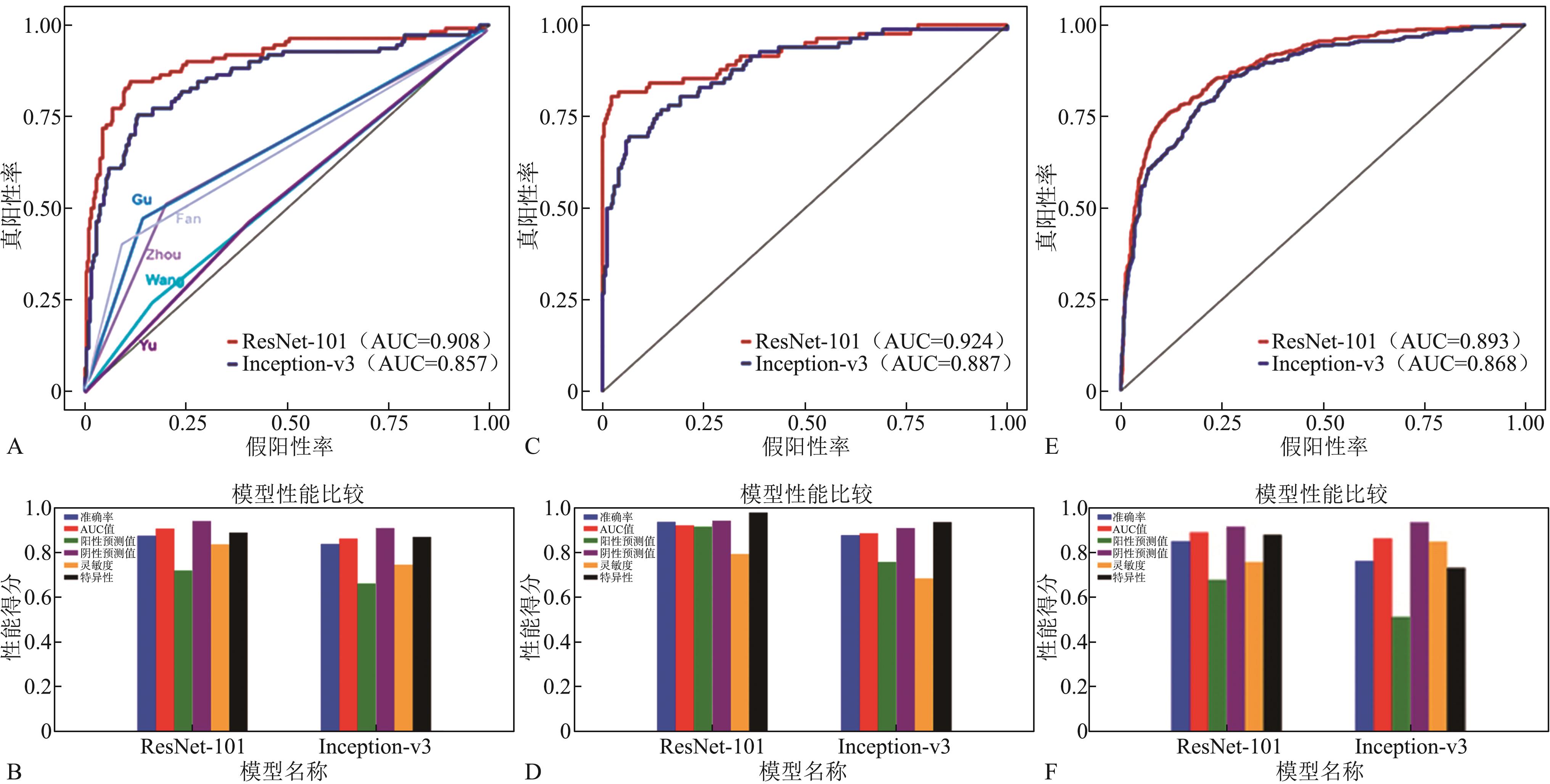
Objective This study aimed to develop a convolutional neural network (CNN)-based deep learning system for detecting three-rooted mandibular first molars (MFMs) on panoramic radiographs and evaluate its diagnostic performance. Methods Cone beam computed tomography (CBCT) and panoramic radiographs were obtained from the Department of Oral Radiology. The patients were assigned into two groups. In group A, CBCT and conventional panoramic images were derived from the same patients, and the dataset comprised image patches of 1 444 MFMs (of which, 367 teeth had three roots). In group B, the patients underwent CBCT examinations in the absence of available panoramic images; CBCT images were acquired and utilized to generate simulated panoramic images, and the dataset consisted of image patches of 1 203 MFMs (of which, 283 teeth had three roots). Two CNNs (ResNet-101 and Inception-v3) were employed to classify three- and two-rooted MFMs based on training and testing with two groups of image patches. Receiver operating characteristic (ROC) curve analyses were performed to assess diagnostic performance, using the CBCT examination as the gold standard. The performance of CNNs was compared with that of five dental professionals. Results Both CNN models achieved satisfactory performance in their respective evaluations. In Group A, the accuracy, sensitivity, and specificity of ResNet-101 were 87.5%, 83.6%, and 88.9%, respectively, and the AUC value (0.908) was significantly higher than 0.857 achieved by Inception-v3 (P<0.01). Notably, the CNN models trained on CBCT-generated panoramic images (group B dataset) achieved comparable performance when tested on conventional panoramic images (group A dataset). For ResNet-101, the accuracy, sensitivity, specificity, and AUC were 85.1%, 75.8%, 88.1%, and 0.893, respectively. The five dental professionals achieved significantly lower diagnostic performance compared with CNNs, and the AUC values were 0.532-0.668. Conclusion The CNN-based deep learning system exhibited a high level of accuracy in detecting three-rooted MFMs on panoramic radiographs. CBCT-generated panoramic images can effectively replace conventional panoramic images in the training of CNN models when the quantity and quality of conventional images are inadequate.

Key words: deep learning, convolutional neural network, panoramic radiography, cone beam computed tomography, mandibular first molar

CLC Number: 

  • R816.98

TrendMD: 

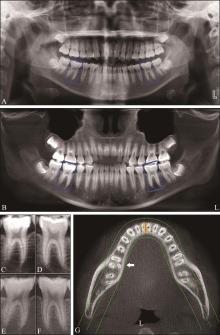
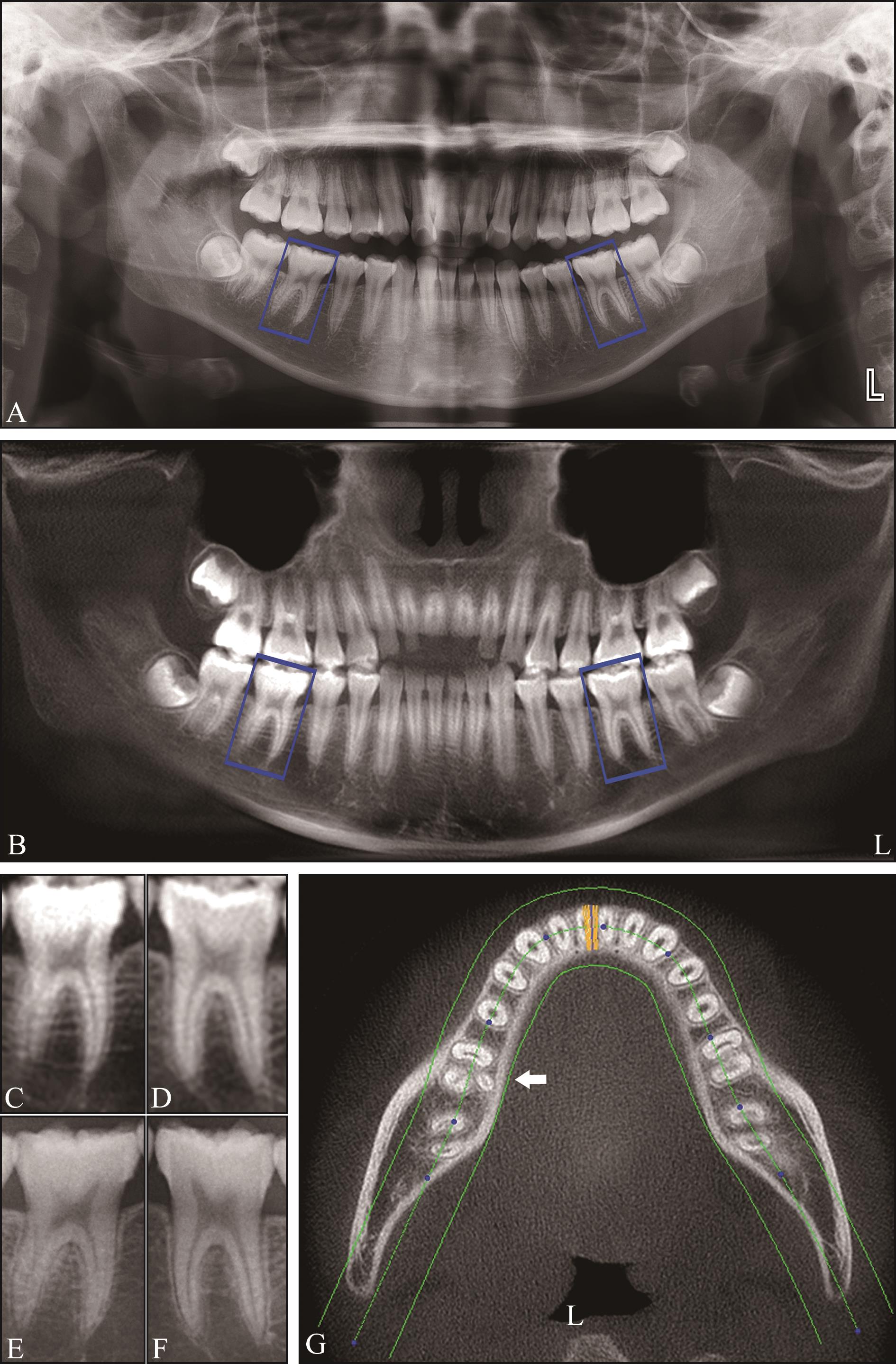
Fig 1

Extraction of MFM image patches"

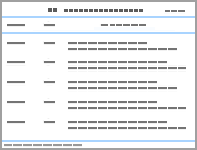
Tab 1

Diagnostic performance of two CNN models and five clinicians"

CNN模型准确率AUC95%渐近置信区间灵敏度特异性阳性预测值阴性预测值F1值
下限上限
A组(常规口腔曲面体层片:1 444 MFM)
ResNet-1010.8750.9080.8690.9450.8360.8890.7190.9410.773
Inception-v30.8380.8570.8180.9050.7450.870.6610.9090.701
高年资医师0.7810.6680.6030.7280.4090.9070.6000.8180.485
低年资医师10.7550.6640.6170.7080.4820.8450.5150.8270.500
低年资医师20.7300.6570.6100.7020.5090.8050.4710.8280.489
硕士研究生10.7300.5410.4920.5880.2460.8360.3370.7650.283
硕士研究生20.5610.5320.4650.5970.4720.5910.3430.7120.348
B组(CBCT生成的模拟口腔曲面体层片:1 203 MFM)
ResNet-1010.9360.9240.8790.9630.7930.9780.9150.9410.850
Inception-v30.8770.8870.8400.9300.6830.9350.7570.9080.718
B组全部图像为训练集,A组全部图像为测试集
ResNet-1010.8510.8930.8720.9130.7580.8810.6780.9170.716
Inception-v30.7620.8680.8410.8870.8500.7330.5120.9370.639

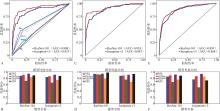
Fig 2

ROC curve analysis of two CNN models and five clinicians in the classification of image patches of MFMs"

[1] Hatipoğlu FP, Mağat G, Hatipoğlu Ö, et al. Assessment of the prevalence of radix entomolaris and distolingual canal in mandibular first molars in 15 countries: a multinational cross-sectional study with meta-analysis[J]. J Endod, 2023, 49(10): 1308-1318.
[2] Martins JNR, Gu Y, Marques D, et al. Differences on the root and root canal morphologies between Asian and white ethnic groups analyzed by cone-beam computed tomography[J]. J Endod, 2018, 44(7): 1096-1104.
[3] Zhang R, Wang H, Tian YY, et al. Use of cone-beam computed tomography to evaluate root and canal morphology of mandibular molars in Chinese individuals[J]. Int Endod J, 2011, 44(11): 990-999.
[4] 汤颖, 裴凡, 陈秀春, 等. 儿童三根型下颌磨牙的CBCT影像学分析[J]. 实用口腔医学杂志, 2024, 40(4): 60-64.
Tang Y, Pei F, Chen XC, et al. CBCT imaging analysis of three-rooted mandibular molars in children[J]. J Pract Stomatol, 2024, 40(4): 60-64.
[5] Gu Y, Lu Q, Wang P, et al. Root canal morphology of permanent three-rooted mandibular first molars: partⅡ—Measurement of root canal curvatures[J]. J Endod, 2010, 36(8): 1341-1346.
[6] Jiang C, Pei F, Wu Y, et al. Investigation of three-rooted deciduous mandibular second molars in a Chinese population using cone-beam computed tomography[J]. BMC Oral Health, 2022, 22(1): 329.
[7] Tu MG, Huang HL, Hsue SS, et al. Detection of permanent three-rooted mandibular first molars by cone-beam computed tomography imaging in Taiwanese individuals[J]. J Endod, 2009, 35(4): 503-507.
[8] Bai B, Tang Y, Wu Y, et al. Ex vivo detection of mandibular incisors’ root canal morphology using cone-beam computed tomography with 4 different voxel sizes and micro-computed tomography[J]. BMC Oral Health, 2023, 23(1): 656.
[9] Singh NK, Raza K. Progress in deep learning-based dental and maxillofacial image analysis: a systema-tic review[J]. Expert Syst Appl, 2022, 199: 116968.
[10] Schwendicke F, Samek W, Krois J. Artificial intelligence in dentistry: chances and challenges[J]. J Dent Res, 2020, 99(7): 769-774.
[11] Lee JH, Kim DH, Jeong SN, et al. Detection and dia-gnosis of dental caries using a deep learning-based convolutional neural network algorithm[J]. J Dent, 2018, 77: 106-111.
[12] Fukuda M, Inamoto K, Shibata N, et al. Evaluation of an artificial intelligence system for detecting vertical root fracture on panoramic radiography[J]. Oral Radiol, 2020, 36(4): 337-343.
[13] Orhan K, Bayrakdar IS, Ezhov M, et al. Evaluation of artificial intelligence for detecting periapical pathosis on cone-beam computed tomography scans[J]. Int Endod J, 2020, 53(5): 680-689.
[14] Hiraiwa T, Ariji Y, Fukuda M, et al. A deep-learning artificial intelligence system for assessment of root morphology of the mandibular first molar on pano-ramic radiography[J]. Dentomaxillofac Radiol, 2019, 48(3): 20180218.
[15] Yang S, Lee H, Jang B, et al. Development and validation of a visually explainable deep learning model for classification of C-shaped canals of the mandibular second molars in periapical and panoramic dental radiographs[J]. J Endod, 2022, 48(7): 914-921.
[16] Jeon SJ, Yun JP, Yeom HG, et al. Deep-learning for predicting C-shaped canals in mandibular second molars on panoramic radiographs[J]. Dentomaxillofac Radiol, 2021, 50(5): 20200513.
[17] He K, Zhang X, Ren S, et al. Deep residual learning for image recognition[J]. IEEE, 2016. doi: 10.1109/CVPR.2016.90 .
doi: 10.1109/CVPR.2016.90
[18] Szegedy C, Ioffe S, Vanhoucke V, et al. Inception-v4, Inception-ResNet and the impact of residual connections on learning[J]. arXiv, 2016. doi: 10.48550/arXiv.1602.07261 .
doi: 10.48550/arXiv.1602.07261
[19] Deng J, Dong W, Socher R, et al. ImageNet: a large-scale hierarchical image database[C]//2009 IEEE Conference on Computer Vision and Pattern Recognition. Miami, USA: IEEE, 2009: 248-255.
[20] Jin L, Zhou W, Tang Y, et al. Detection of C-shaped mandibular second molars on panoramic radiographs using deep convolutional neural networks[J]. Clin Oral Investig, 2024, 28(12): 646.
[21] 齐帅, 张旗. 卷积神经网络在牙体牙髓病影像诊断中的研究和应用[J]. 口腔医学研究, 2023, 39(11): 960-964.
Qi S, Zhang Q. Research and application of convolutional neural network in endodontic imaging diagnosis[J]. J Oral Sci Res, 2023, 39(11): 960-964.
[1] Jing Lan,Jun Wu. Contrastive analysis of occlusal plane canting among adult patients with average-angle profiles with class Ⅰ, class Ⅱ1, and class Ⅲ malocclusions [J]. Int J Stomatol, 2026, 53(1): 26-35.
[2] Chaoying Lin,Lan Zhang,Dingming Huang. Research progress of artificial intelligence in root canal therapy [J]. Int J Stomatol, 2025, 52(5): 572-578.
[3] Xiaojie Zhou,Benxiang Hou. Research progress on the methods for caries diagnosis based on deep learning [J]. Int J Stomatol, 2025, 52(5): 579-585.
[4] Meichang Huang,Hongjie Jiang,Yaling Tang,Lihong Yao. Cone beam computed tomography and immunohistochemical staining for the diagnosis and differential diagnosis of periapical cysts [J]. Int J Stomatol, 2025, 52(4): 490-497.
[5] Yunyi Wang,Zhu Zhu,Feng Zhang. Progress of research on using artificial intelligence for cephalometric automatic-landmarking algorithms [J]. Int J Stomatol, 2024, 51(5): 630-641.
[6] Xinyue Chen,Xiaoyu Pan,Yan Yang,Yuanyuan Jia,Liang Chen. Application progress of convolution neural network in endodontics [J]. Int J Stomatol, 2024, 51(4): 483-488.
[7] Liu Panming,Li Zhengze,Li Junhe,Cui Shuxia.. Cone beam computed tomography study of maxillary sinus volume and oropharyngeal airway volume with diffe-rent vertical skeletal faces in adult skeletal Class Ⅱ patients [J]. Int J Stomatol, 2023, 50(5): 528-537.
[8] Yang Yunan,Liu Peng,Wang Hu,You Meng. Evaluation of maxillary sinusitis with cone beam computed tomography [J]. Int J Stomatol, 2023, 50(3): 302-307.
[9] Wu Wenzhi,Feng Da-xing,Chen Chuizhuang,Zhou Lijuan.. Incidence and related factors of middle mesial canals in mandibular first molars in Haikou [J]. Int J Stomatol, 2022, 49(4): 420-425.
[10] Ye Zelin,Liu Lu,Long Hu,You Meng. Research progress on imaging evaluation and treatment of anterior dilacerated teeth [J]. Int J Stomatol, 2022, 49(2): 173-181.
[11] Liu Lijia,Mao Jing,Long Huan,Pu Yalong,Wang Jun. Research progress on two-dimensional and three-dimensional cephalometric automatic landmarking [J]. Int J Stomatol, 2022, 49(1): 100-108.
[12] Zhou Mengqi,Chen Xuepeng,Fu Baiping. Strategies for preventing alveolar-bone dehiscence and fenestration during orthodontic treatment [J]. Int J Stomatol, 2021, 48(5): 600-608.
[13] Shi Danni,Yang Xin,Wu Jianyong. Research progress of reference coordinate system for three-dimensional cephalometric based on cone beam computed tomography [J]. Int J Stomatol, 2021, 48(4): 398-404.
[14] Wu Chunlan,Tang Hua,Chen Jun. Alveolar bone morphology of anterior teeth areas in patients with high-angle skeletal Class Ⅱ open bite [J]. Int J Stomatol, 2021, 48(4): 426-432.
[15] Wang Lidong,Ma Wen,Fu Shuai,Zhang Changbin,Cui Qingying,Liang Yan,Li Ming. Research and accuracy of different methods of digital occlusal splint fabrication for orthognathic surgery [J]. Int J Stomatol, 2021, 48(2): 156-164.
Viewed
Full text


Abstract

Cited

  Shared   
  Discussed   
No Suggested Reading articles found!