Int J Stomatol ›› 2026, Vol. 53 ›› Issue (1): 26-35.doi: 10.7518/gjkq.2026004

• Orthodontics • Previous Articles     Next Articles

Contrastive analysis of occlusal plane canting among adult patients with average-angle profiles with class Ⅰ, class Ⅱ1, and class Ⅲ malocclusions

Jing Lan(),Jun Wu()   

  1. Dept. of Orthodontics, Affiliated Stomatological Hospital of Nanchang University, Jiangxi Key Laboratory of Stomatology, Jiangxi Clinical Medical Research Center for Oral Diseases, Nanchang 330000, China
  • Received:2024-11-28 Revised:2025-03-07 Online:2026-01-01 Published:2025-12-31
  • Contact: Jun Wu E-mail:17807069105@163.com;wujundent@163.com

Abstract:

Objective This study aims to investigate the correlation between the inclination of the occlusal plane of maxillary canines and first molars in adult patients with different sagittal skeletal patterns, as well as the differences in the direction of occlusal plane inclination and the sagittal relationship of molars between Angle’s subclasses, which provides a reference for the clinical treatment of such patients. Methods A total of 180 adult patients with normal occlusion were selected, including 60 cases of Angle class Ⅰ, 60 cases of Angle class Ⅱ division 1, and 60 cases of Angle class Ⅲ (with 30 cases of subclass and non-subclass for Angle class Ⅱ division 1 and Ⅲ). Three-dimensional reconstruction of cone beam computed tomography was performed using Mimics software. The vertical distances from the maxillary bilateral canines and first molars to the Frankfort horizontal plane were measured, and the inclination of the occlusal plane was calculated. The direction of the occlusal plane inclination and the sagittal relationship of the molars were recorded. SPSS 26.0 software was used to statistically analyze the correlation between the inclination of the occlusal plane and diffe-rent sagittal skeletal patterns. The correlation between the sagittal relationship of molars and the direction of occlusal plane inclination in Angle subclasses was also explored. Results A correlation existed between the inclination of the occlusal plane of canines and first molars and different sagittal skeletal groups (P<0.05). A correlation existed between the inclination of the occlusal plane in Angle subclass groups and non-subclass groups (P<0.05). In the Angle subclass group, a correlation existed between the bilateral molar relationships and the direction of occlusal plane inclination (P<0.05). Conclusion Certain differences are observed in the inclination of the occlusal plane in adult patients with different sagittal skeletal patterns. The correction of the occlusal plane inclination should not be ignored in the clinical diagnosis, analysis, and treatment of patients with Angle class Ⅱ and Angle class Ⅲ, as well as their subclass.

Key words: occlusal plane cant, cone beam computed tomography, Angle class Ⅲ, Angle class Ⅱ, sagittal direction

CLC Number: 

  • R783.5

TrendMD: 

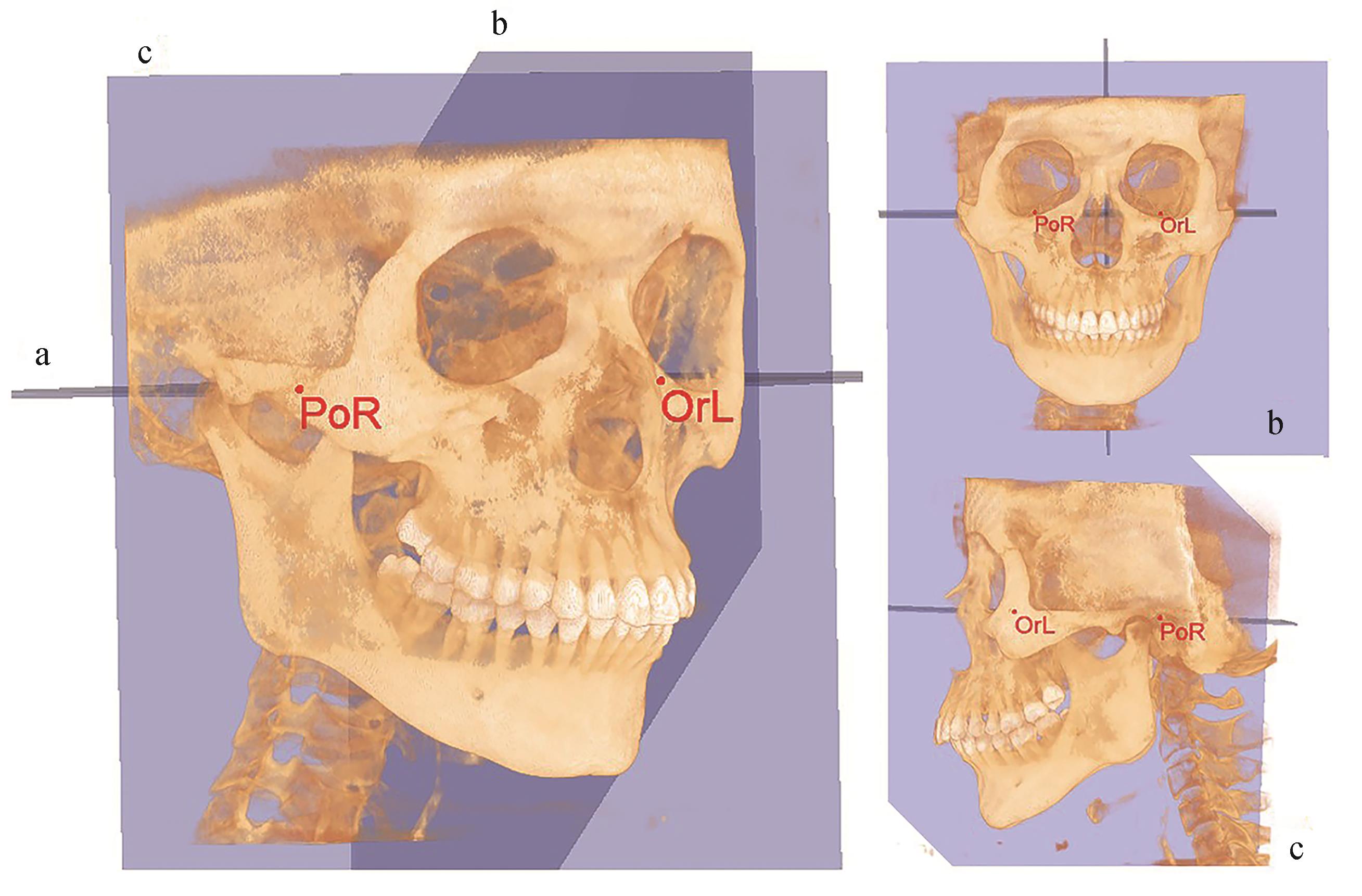
Fig 1

Create reference planes in 3D orientation in Mimics"

Tab 1

Measurement landmarks for occlusal plane canting"

标志点含义定位方法
Po(L,R)耳点(左侧,右侧)左、右侧外耳道之最上点
Or(L,R)眶下点(左侧,右侧)左、右侧眶下缘最低点
N鼻根点鼻额缝的最前点
Ba颅底点枕骨大孔前缘之中点
R6\L6上颌第一磨牙近中颊尖顶点左、右侧上颌第一磨牙近中颊尖顶点
R3\L3上颌尖牙牙尖顶点左、右侧上颌尖牙牙尖顶点
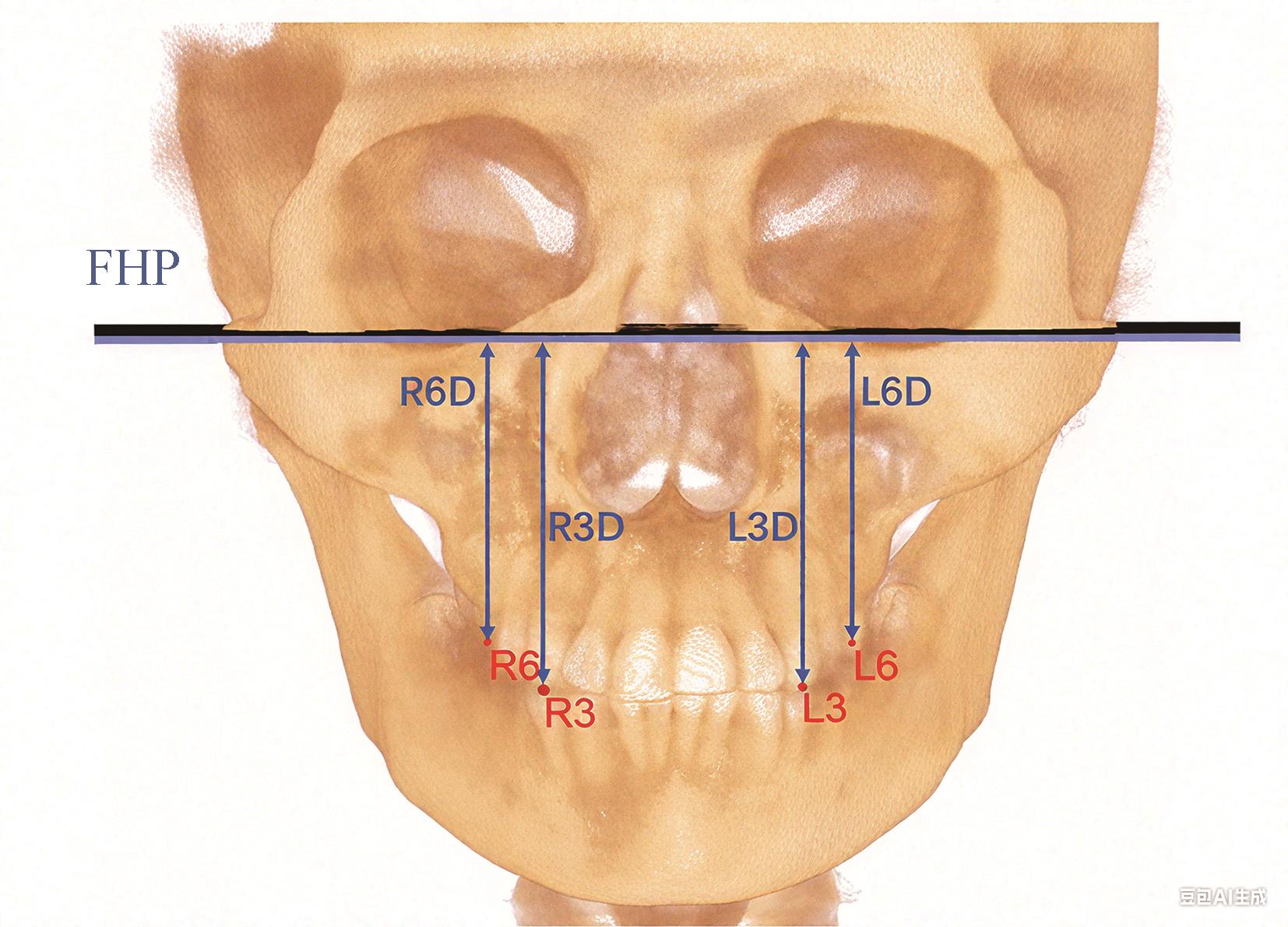
R3D\L3D上颌尖牙牙尖顶点至FHP距离左、右上颌尖牙牙尖顶点至FHP的垂直距离
R3D\L6D上颌第一磨牙近中颊尖顶点至FHP距离左、右上颌第一磨牙近中颊尖顶点至FHP的垂直距离
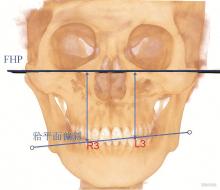
OC3上颌尖牙??平面偏斜量上颌左右两侧尖牙牙尖顶点(R3、L3)至FHP的距离差,即OC3=|R3D-L3D|
OC6上颌磨牙??平面偏斜量上颌左右两侧第一磨牙近中颊尖顶点(R6、L6)至FHP的距离差,即OC6=|R6D-L6D|

Fig 2

Measurement diagram of OC3 and OC6"

Fig 3

Schematic diagram of occlusal plane canting direction"

Fig 4

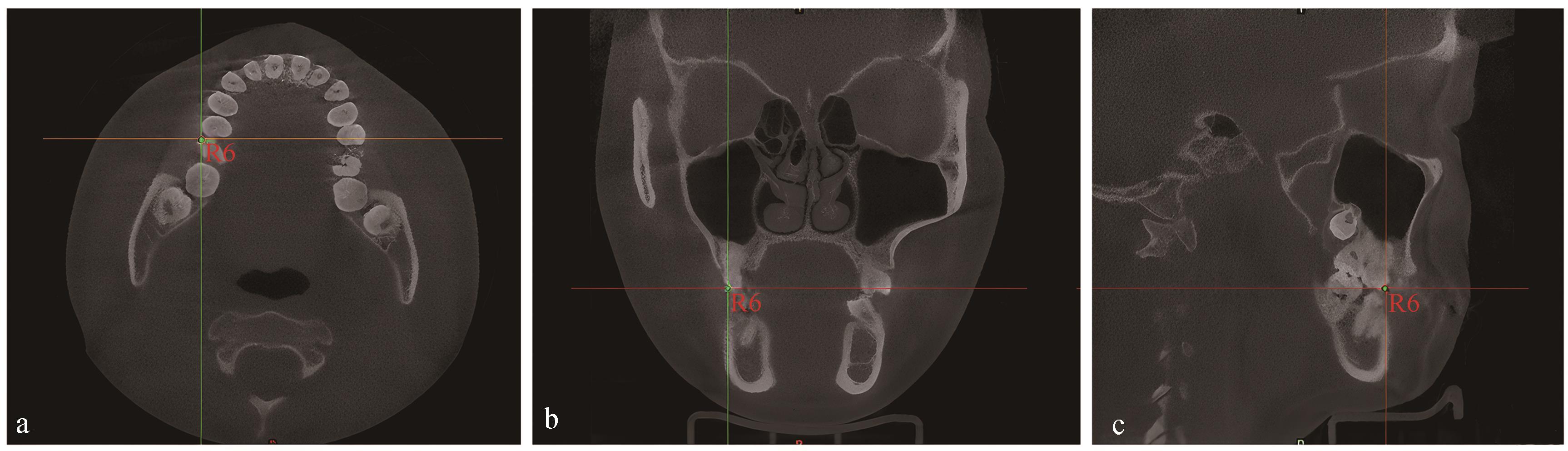
Three-dimensional directional fixation in Mimics software (using the R6 point of the mesial buccal tip of the right maxillary first molar as an example)"

Tab 2

General data of patients in each group"

基本信息Ⅰ组NSNSχ2/ZP
性别(n/%)37/61.621/70.015/50.014/46.720/33.30.2670.992
23/38.39/30.015/50.016/53.310/66.6
年龄/岁22.10±1.5120.80±1.5520.90±1.5221.70±1.8921.90±1.992.0490.091
∠ANB/°0.92±1.451.90±1.422.40±0.87-2.82±1.21-2.24±2.0514.269<0.001**
∠MP-FH/°28.40±0.9027.90±0.4529.80±0.5628.50±2.5429.00±0.61109.580.656

Tab 3

Comparison of OC3 and OC6 among groups Ⅰ, Ⅱ and Ⅲ"

??平面偏斜量Ⅰ组(n=60)Ⅱ组(n=60)Ⅲ组(n=60)HP
OC30.30(0.18,0.5)0.40(0.23,0.68)a0.60(0.4,1.0)a,b20.06<0.001**
OC60.30(0.2,0.5)0.50(0.2,0.88)0.80(0.3,1.3)a,b12.70<0.05*

Tab 4

Comparison of OC3 and OC6 between group Ⅱ S and group ⅡN mm/(Q25,Q75)"

??平面偏斜量Nn=60)Sn=60)ZP
OC30.40(0.20,0.60)0.55(0.30,1.35)2.460.01*
OC60.30(0.20,0.50)0.80(0.20,1.53)3.47<0.001**

Tab 5

Comparison of OC3 and OC6 between group Ⅲ S and group ⅢN"

??平面偏斜量Nn=30)Sn=30)ZP
OC30.60(0.20,0.80)0.70(0.50,1.55)2.540.011*
OC60.50(0.10,1.23)0.90(0.50,1.33)1.970.049*

Tab 6

Correlation analysis of sagittal molar rela-tionship and deviation direction in group ⅡS (canine region)"

偏斜方向例数尖牙区(n/%)P
右侧亚类左侧亚类
+1815/83.33/16.70.001**
-122/16.710/83.3

Tab 7

Correlation analysis of sagittal molar relation-ship and deviation direction in group ⅡS (first-molar region)"

偏斜方向例数第一磨牙区(n/%)P
右侧亚类左侧亚类
+1111/100.00/0.00.001**
-196/31.613/68.4

Tab 8

Correlation analysis of sagittal positions of the left and right sides and deviation direction in group Ⅲ S (canine and first-molar regions)"

偏斜方向例数尖牙及第一磨牙区(n/%)P
右侧亚类左侧亚类
+1919/100.00/0.00.001**
-110/0.019/100.0

Tab 9

Comparison of OC3 and OC6 measurements mm/(Q25,Q75 )"

组别OC3OC6ZP
0.30(0.18,0.50)0.30(0.20,0.50)0.520.60
N0.40(0.20,0.60)0.30(0.20,0.50)0.490.62
S0.55(0.30,1.35)0.80(0.20,1.53)0.680.50
N0.60(0.20,0.80)0.50(0.10,1.23)0.190.85
S0.70(0.50,1.55)0.90(0.50,1.33)0.080.94
[1] Dewey M. Classification of malocclusion[J]. Int J Orthod, 1915, 1(3): 133-147.
[2] Burstone CJ. Diagnosis and treatment planning of patients with asymmetries[J]. Semin Orthod, 1998, 4(3): 153-164.
[3] Janson G, Cruz KS, Woodside DG, et al. Dentoske-letal treatment changes in class Ⅱ subdivision malocclusions in submentovertex and posteroanterior radiographs[J]. Am J Orthod Dentofacial Orthop, 2004, 126(4): 451-463.
[4] Sabri R. The eight components of a balanced smile[J]. J Clin Orthod, 2005, 39(3): 155-167.
[5] Stahl F, Baccetti T, Franchi L, et al. Longitudinal growth changes in untreated subjects with class Ⅱ division 1 malocclusion[J]. Am J Orthod Dentofacial Orthop, 2008, 134(1): 125-137.
[6] Shackelford TK, Larsen RJ. Facial asymmetry as an indicator of psychological, emotional, and physiological distress[J]. J Pers Soc Psychol, 1997, 72(2): 456-466.
[7] Susarla SM, Peacock ZS, Kaban LB. Evaluation and correction of facial asymmetry in the coronal plane[J]. J Craniofac Surg, 2014, 25(4): 1299-1301.
[8] Azevedo AR, Janson G, Henriques JF, et al. Evaluation of asymmetries between subjects with class Ⅱ subdivision and apparent facial asymmetry and those with normal occlusion[J]. Am J Orthod Dentofacial Orthop, 2006, 129(3): 376-383.
[9] 白丁, 赵志河. 口腔正畸策略、控制与技巧[M]. 北京: 人民卫生出版社, 2015: 139-140.
Bai D, Zhao ZH. Advanced strategy with positive control in orthodontics[M]. Beijing: People’s Medical Publishing House, 2015: 139-140.
[10] Lonic D, Sundoro A, Lin HH, et al. Selection of a horizontal reference plane in 3D evaluation: identifying facial asymmetry and occlusal cant in orthognathic surgery planning[J]. Sci Rep, 2017, 7(1): 2157.
[11] Chia MS, Naini FB, Gill DS. The aetiology, diagnosis and management of mandibular asymmetry[J]. Orthod Update, 2008, 1(2): 44-52.
[12] Kurt G, Uysal T, Sisman Y, et al. Mandibular asymmetry in class Ⅱ subdivision malocclusion[J]. Angle Orthod, 2008, 78(1): 32-37.
[13] Rose JM, Sadowsky C, BeGole EA, et al. Mandibular skeletal and dental asymmetry in class Ⅱ subdivision malocclusions[J]. Am J Orthod Dentofacial Orthop, 1994, 105(5): 489-495.
[14] Kanurkova L, Gjorgova J, Dzipunova B, et al. Association between condylar position and tilt of frontal occlusal plane in patients with transversal and vertical dentofacial discrepancy[J]. Balk J Stom, 2012, 16(3): 147-153.
[15] Pluijmers BI, van de Lande LS, Caron CJJM, et al. Part 2: is the maxillary canting and its surgical correction in patients with CFM correlated to the mandibular deformity[J]. J Craniomaxillofac Surg, 2018, 46(9): 1436-1440.
[16] Rhodes G, Sumich A, Byatt G. Are average facial configurations attractive only because of their symmetry[J]. Psychol Sci, 1999, 10(1): 52-58.
[17] Ramirez-Yañez GO, Stewart A, Franken E, et al. Prevalence of mandibular asymmetries in growing patients[J]. Eur J Orthod, 2011, 33(3): 236-242.
[18] Good S, Edler R, Wertheim D, et al. A computerized photographic assessment of the relationship between skeletal discrepancy and mandibular outline asymmetry[J]. Eur J Orthod, 2006, 28(2): 97-102.
[19] Severt TR, Proffit WR. The prevalence of facial asymmetry in the dentofacial deformities population at the University of North Carolina[J]. Int J Adult Orthodon Orthognath Surg, 1997, 12(3): 171-176.
[20] 刘帅. 双侧下颌角点垂直向不调的骨性Ⅲ类偏斜患者上颌骨横向及垂直向发育形态特征的研究[D]. 沈阳: 中国医科大学, 2019.
Liu S. A study on the lateral and vertical developmental morphological characteristics of maxilla in patients with skeletal class Ⅲ deviation with vertical imbalance of bilateral mandibular angles[D]. Shenyang: China Medical University, 2019.
[21] 刘翔, 陈文静. 基于CBCT成像的成人安氏Ⅲ类颅颌面骨性不对称分析[J]. 口腔医学, 2017, 37(3): 233-236.
Liu X, Chen WJ. Skeletal and dental analysis of class Ⅲ subdivision malocclusions using cone-beam computed tomography[J]. Stomatology, 2017, 37(3): 233-236.
[22] Masuoka N, Momoi Y, Ariji Y, et al. Can cephalometric indices and subjective evaluation be consistent for facial asymmetry[J]. Angle Orthod, 2005, 75(4): 651-655.
[23] Cevidanes LHS, Styner MA, Proffit WR. Image analysis and superimposition of 3-dimensional cone-beam computed tomography models[J]. Am J Orthod Dentofacial Orthop, 2006, 129(5): 611-618.
[24] 王玉俏. 安氏Ⅲ类偏颌畸形患者下颌硬组织以及解剖学𬌗平面的三维分析[D]. 青岛: 青岛大学, 2020.
Wang YQ. Three-dimensional analysis of mandibular hard tissue and anatomical occlusal plane in patients with Angle Ⅲ malocclusion[D]. Qingdao: Qingdao University, 2020.
[25] Baek SH, Cho IS, Chang YI, et al. Skeletodental factors affecting chin point deviation in female patients with class Ⅲ malocclusion and facial asymmetry: a three-dimensional analysis using computed tomography[J]. Oral Surg Oral Med Oral Pathol Oral Radiol Endod, 2007, 104(5): 628-639.
[26] 朱玉, 马嘉, 阎秀林, 等. 骨性安氏Ⅲ类错𬌗伴偏颌患者下颌骨偏斜程度与下颌骨形态和肌功能不对称指数相关性研究[J]. 中国实用口腔科杂志, 2015, 8(6): 368-370.
Zhu Y, Ma J, Yan XL, et al. Correlationship between mandibular asymmetry and the asymmetry index of mandibular profile and muscle functions in patients with skeletal Angle class Ⅲ malocclusion combined with mandibular asymmetry[J]. Chin J Pract Stomatol, 2015, 8(6): 368-370.
[27] 李鸿艺, 周诺, 黄旋平, 等. 应用三维有限元分析骨性Ⅲ类偏颌畸形的生物力学研究[C]//中华口腔医学会口腔医学计算机专业委员会. 第十五次全国口腔医学计算机应用学术研讨会会议手册. 南宁: 广西医科大学附属口腔医院, 2017: 77.
Li HY, Zhou N, Huang XP, et al. Biomechanical study on skeletal class Ⅲ maxillary/mandibular asymmetry using three-dimensional finite element analysis[C]. Chinese Stomatological Association Computer Professional Committee for Oral Medicine. Handbook for the 15th National Symposium on Computer Applications in Oral Medicine. Nanning: Stomatological Hospital Affiliated to Guangxi Medical University, 2017: 77.
[28] Haraguchi S, Iguchi Y, Takada K. Asymmetry of the face in orthodontic patients[J]. Angle Orthod, 2008, 78(3): 421-426.
[29] Sanders DA, Rigali PH, Neace WP, et al. Skeletal and dental asymmetries in class Ⅱ subdivision malocclusions using cone-beam computed tomography[J]. Am J Orthod Dentofacial Orthop, 2010, 138(5): 542.e1-542.e20.
[30] 徐静, 朱双林, 潘昱, 等. 安氏Ⅱ类亚类错𬌗颅颌面结构三维形态分析[J]. 中国实用口腔科杂志, 2015, 8(5): 290-293.
Xu J, Zhu SL, Pan Y, et al. Three-dimensional dentofacial characteristic analysis in class Ⅱ subdivision malocclusion[J]. Chin J Pract Stomatol, 2015, 8(5): 290-293.
[31] Al-Khateeb EAA, Al-Khateeb SN. Anteroposterior and vertical components of class Ⅱ division 1 and division 2 malocclusion[J]. Angle Orthod, 2009, 79(5): 859-866.
[32] 段晓媛. 正面𬌗平面倾斜者的牙及牙槽骨形态学研究[D]. 昆明: 昆明医科大学, 2021.
Duan XY. Morphological study of teeth and alveolar bone in persons with frontal occlusal plane inclined[D]. Kunming: Kunming Medical University, 2021.
[33] Janson G, de Lima KJ, Woodside DG, et al. Class Ⅱ subdivision malocclusion types and evaluation of their asymmetries[J]. Am J Orthod Dentofacial Orthop, 2007, 131(1): 57-66.
[34] Uesugi S, Yonemitsu I, Kokai S, et al. Features in subjects with the frontal occlusal plane inclined toward the contralateral side of the mandibular deviation[J]. Am J Orthod Dentofacial Orthop, 2016, 149(1): 46-54.
[35] 贾绮林, 黄金芳. 颜面不对称畸形的颅面骨骼结构及其生长发育的研究[J]. 中华口腔医学杂志, 1994, 29(1): 34-37.
Jia QL, Huang JF. Study on the craniofacial skeletal structure and its growth and development in facial asymmetry deformity[J]. Chin J Stomatol, 1994, 29(1): 34-37.
[36] Linden OE, He JK, Morrison CS, et al. The relationship between age and facial asymmetry[J]. Plast Reconstr Surg, 2018, 142(5): 1145-1152.
[1] Meichang Huang,Hongjie Jiang,Yaling Tang,Lihong Yao. Cone beam computed tomography and immunohistochemical staining for the diagnosis and differential diagnosis of periapical cysts [J]. Int J Stomatol, 2025, 52(4): 490-497.
[2] Liu Panming,Li Zhengze,Li Junhe,Cui Shuxia.. Cone beam computed tomography study of maxillary sinus volume and oropharyngeal airway volume with diffe-rent vertical skeletal faces in adult skeletal Class Ⅱ patients [J]. Int J Stomatol, 2023, 50(5): 528-537.
[3] Yang Yunan,Liu Peng,Wang Hu,You Meng. Evaluation of maxillary sinusitis with cone beam computed tomography [J]. Int J Stomatol, 2023, 50(3): 302-307.
[4] Zhang Shan,Ge Xiaolei,Li Jie,Xie Xinyu,Chang Weiwei,Ma Wensheng.. Meta-analysis of the long-term effect of maxillary protraction on jaw growth and development [J]. Int J Stomatol, 2022, 49(5): 548-555.
[5] Ye Zelin,Liu Lu,Long Hu,You Meng. Research progress on imaging evaluation and treatment of anterior dilacerated teeth [J]. Int J Stomatol, 2022, 49(2): 173-181.
[6] Liu Lijia,Mao Jing,Long Huan,Pu Yalong,Wang Jun. Research progress on two-dimensional and three-dimensional cephalometric automatic landmarking [J]. Int J Stomatol, 2022, 49(1): 100-108.
[7] Zhou Mengqi,Chen Xuepeng,Fu Baiping. Strategies for preventing alveolar-bone dehiscence and fenestration during orthodontic treatment [J]. Int J Stomatol, 2021, 48(5): 600-608.
[8] Shi Danni,Yang Xin,Wu Jianyong. Research progress of reference coordinate system for three-dimensional cephalometric based on cone beam computed tomography [J]. Int J Stomatol, 2021, 48(4): 398-404.
[9] Wu Chunlan,Tang Hua,Chen Jun. Alveolar bone morphology of anterior teeth areas in patients with high-angle skeletal Class Ⅱ open bite [J]. Int J Stomatol, 2021, 48(4): 426-432.
[10] Wang Lidong,Ma Wen,Fu Shuai,Zhang Changbin,Cui Qingying,Liang Yan,Li Ming. Research and accuracy of different methods of digital occlusal splint fabrication for orthognathic surgery [J]. Int J Stomatol, 2021, 48(2): 156-164.
[11] Wang Ben,Xu Zhezhen,Wei Xi. Application and progress of a digitalized minimally invasive technique in endodontics [J]. Int J Stomatol, 2021, 48(1): 110-118.
[12] Zhang Zihan,Xiong Xin,Wang Jun. Research status and application development of three-dimensional cephalometry [J]. Int J Stomatol, 2020, 47(6): 739-744.
[13] Tang Bei,Zhao Wenjun,Wang Hu,Zheng Guangning,You Meng. Inferior alveolar nerve injury due to apical overfilling: two cases reports [J]. Int J Stomatol, 2020, 47(3): 293-296.
[14] Zhang Tingting,Hu Changhong,Peng Yan,Zhou Wenqiao,Zhang Huicong,Liu Die. Analysis of upper lip profile features in 300 dentate subjects of different ages via three-dimensional measurement of cone beam computed tomography [J]. Int J Stomatol, 2020, 47(2): 182-188.
[15] Li Qi, Huang Shaohong. Cone beam computed tomography study on root and root canal morphology of mandibular second permanent molars in Guangfu population in Lingnan area [J]. Int J Stomatol, 2019, 46(6): 640-649.
Viewed
Full text


Abstract

Cited

  Shared   
  Discussed   
No Suggested Reading articles found!