国际口腔医学杂志 ›› 2026, Vol. 53 ›› Issue (4): 545-553.doi: 10.7518/gjkq.2026225
• 论著 • 上一篇
张欣1( ),袁梦1,岳玉凤1,段小燕2()
Xin Zhang1(),Meng Yuan1,Yufeng Yue1,Xiaoyan Duan2()
摘要:
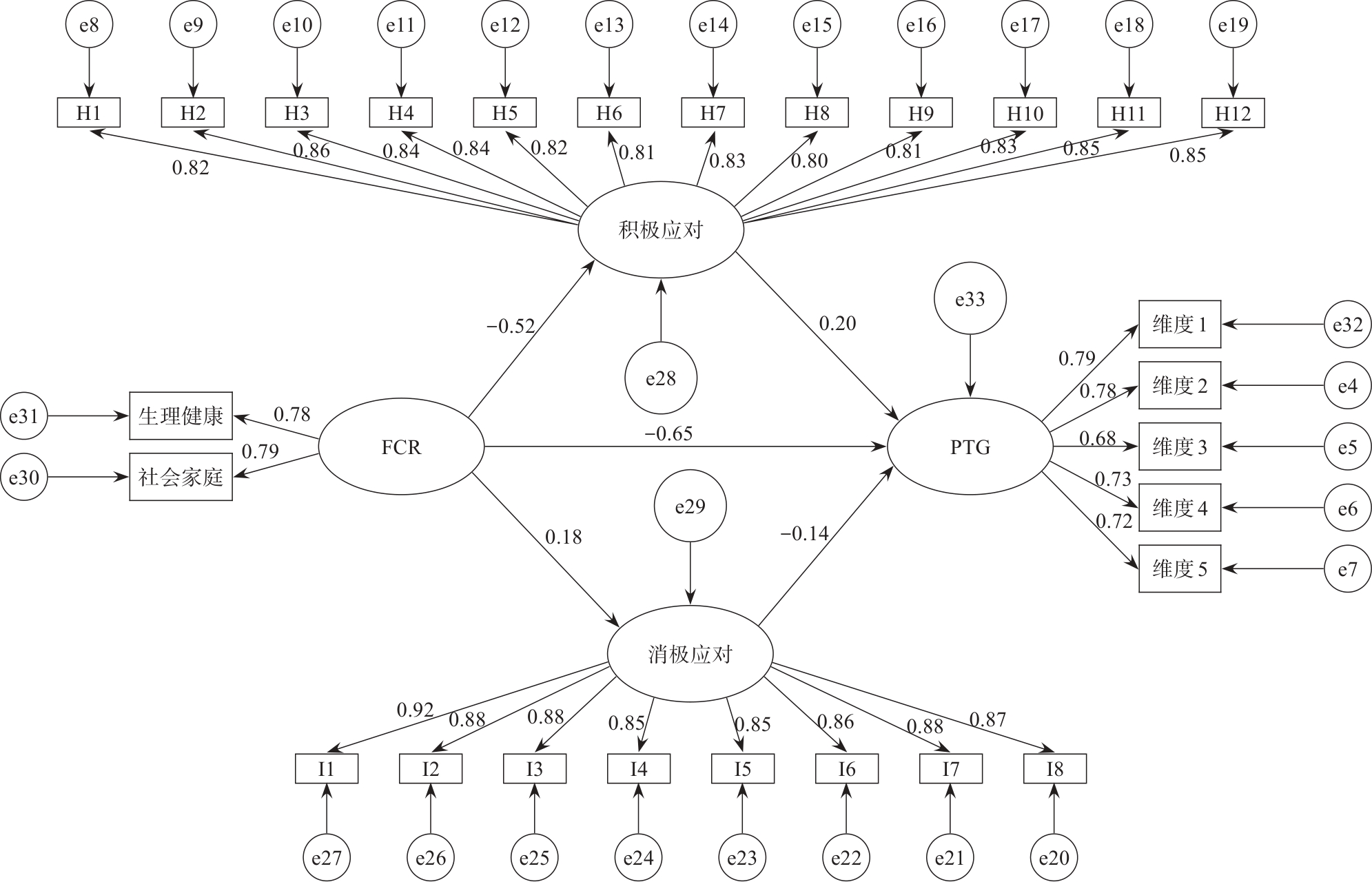
目的 探讨口腔癌患者创伤后成长的现状,分析癌症复发恐惧、应对方式对创伤后成长的影响,为提高口腔癌患者创伤后成长水平提供依据。 方法 采用便利抽样法,于2023年9月—2024年4月从重庆市3所三级甲等医院招募255名口腔癌患者作为研究对象,使用创伤后成长评定量表、简易恐惧疾病进展量表、简易应对方式量表对口腔癌患者进行问卷调查。 结果 口腔癌患者的创伤后成长得分、癌症复发恐惧得分、积极应对方式得分和消极应对方式得分分别为56.88±18.69、32.55±9.77、19.86±9.82、8.72±6.76,创伤后成长与癌症复发恐惧、消极应对方式存在显著负相关(r=-0.646、-0.219,P<0.05),与积极应对方式呈显著正相关(r=0.482,P<0.05)。应对方式在癌症复发恐惧与创伤后成长之间起部分中介作用(P<0.05),中介效应值为0.132,占总效应的16.80%。 结论 口腔癌患者的创伤后成长水平有待提升,通过减轻癌症复发恐惧、倡导积极的应对方式,可以有效促进患者的创伤后成长。
中图分类号:
| [1] | Siegel RL, Giaquinto AN, Jemal A. Cancer statistics, 2024[J]. CA Cancer J Clin, 2024, 74(1): 12-49. |
| [2] | Han B, Zheng R, Zeng H, et al. Cancer incidence and mortality in China, 2022[J]. J Natl Cancer Cent, 2024, 4(1): 47-53. |
| [3] | 王太萍, 石兴莲, 龚玲, 等. 口腔癌患者术后生存质量的研究进展[J]. 护士进修杂志, 2022, 37(9): 813-818. |
| Wang TP, Shi XL, Gong L, et al. Research progress of postoperative quality of life in the patients with oral cancer[J]. J Nurs Train, 2022, 37(9): 813-818. | |
| [4] | 国家卫生健康委员会. 全国护理事业发展规划(2021—2025年)[J]. 中国护理管理, 2022, 22(6): 801- 804. |
| National Health Commission. National nursing development plan (2021—2025)[J]. Chin Nurs Manag, 2022, 22(6): 801-804. | |
| [5] | Absolom K, British Psychosocial Oncology Society. Psycho-Oncology 30 years celebrations[J]. Psycho-Oncology, 2022, 31(4): 558. |
| [6] | Tedeschi RG, Calhoun LG. Posttraumatic growth: conceptual foundations and empirical evidence[J]. Psychol Inq, 2004, 15(1): 1-18. |
| [7] | Shand LK, Cowlishaw S, Brooker JE, et al. Correlates of post-traumatic stress symptoms and growth in cancer patients: a systematic review and meta-analysis[J]. Psycho-Oncology, 2015, 24(6): 624-634. |
| [8] | Menger F, Mohammed Halim NA, Rimmer B, et al. Post-traumatic growth after cancer: a scoping review of qualitative research[J]. Support Care Cancer, 2021, 29(11): 7013-7027. |
| [9] | Tomich PL, Helgeson VS. Posttraumatic growth following cancer: links to quality of life[J]. J Trauma Stress, 2012, 25(5): 567-573. |
| [10] | Casellas-Grau A, Ochoa C, Ruini C. Psychological and clinical correlates of posttraumatic growth in cancer: a systematic and critical review[J]. Psycho-Oncology, 2017, 26(12): 2007-2018. |
| [11] | Folkman S. Personal control and stress and coping processes: a theoretical analysis[J]. J Pers Soc Psychol, 1984, 46(4): 839-852. |
| [12] | Lebel S, Ozakinci G, Humphris G, et al. From normal response to clinical problem: definition and clinical features of fear of cancer recurrence[J]. Support Care Cancer, 2016, 24(8): 3265-3268. |
| [13] | Nik Jaafar NR, Hamdan NA, Abd Hamid N, et al. Posttraumatic growth and its association with unmet supportive care needs and fear of cancer progression among head and neck cancer patients[J]. PLoS One, 2022, 17(3): e0265502. |
| [14] | Eissenstat SJ, Kim S, Kim B. A meta-study of posttraumatic growth and coping strategies[J]. Psychol Rep, 2024, 127(4): 1588-1612. |
| [15] | Nipp RD, El-Jawahri A, Fishbein JN, et al. The relationship between coping strategies, quality of life, and mood in patients with incurable cancer[J]. Cancer, 2016, 122(13): 2110-2116. |
| [16] | 宋媛媛, 蒋晓莲. 癌症病人创伤后成长纵向研究进展[J]. 护理研究, 2022, 36(4): 659-663. |
| Song YY, Jiang XL. Longitudinal research progress on posttraumatic growth of cancer patients[J]. Chin Nurs Res, 2022, 36(4): 659-663. | |
| [17] | 李峥, 刘宇. 护理学研究方法[M]. 2版. 北京: 人民卫生出版社, 2018. |
| Li Z, Liu Y. Nursing research methods[M]. 2nd ed. Beijing: People’s Health Publishing House, 2018. | |
| [18] | Tedeschi RG, Calhoun LG. The posttraumatic grow-th inventory: measuring the positive legacy of trauma[J]. J Trauma Stress, 1996, 9(3): 455-471. |
| [19] | 汪际, 陈瑶, 王艳波, 等. 创伤后成长评定量表的修订及信效度分析[J]. 护理学杂志, 2011, 26(14): 26-28. |
| Wang J, Chen Y, Wang YB, et al. Revision of the posttraumatic growth inventory and testing its relia-bility and validity[J]. J Nurs Sci, 2011, 26(14): 26-28. | |
| [20] | 张世慧, 魏清风, 万显秀, 等. 口腔癌患者术后创伤后成长状况及影响因素分析[J]. 护理学杂志, 2017, 32(4): 76-79. |
| Zhang SH, Wei QF, Wan XX, et al. The level and factors associated with posttraumatic growth among patients with oral cancer after operation[J]. J Nurs Sci, 2017, 32(4): 76-79. | |
| [21] | Mehnert A, Herschbach P, Berg P, et al. Fear of progression in breast cancer patients—validation of the short form of the Fear of Progression Questionnaire (FoP-Q-SF)[J]. Z Psychosom Med Psychother, 2006, 52(3): 274-288. |
| [22] | 吴奇云, 叶志霞, 李丽, 等. 癌症患者恐惧疾病进展简化量表的汉化及信效度分析[J]. 中华护理杂志, 2015, 50(12): 1515-1519. |
| Wu QY, Ye ZX, Li L, et al. Reliability and validity of Chinese version of Fear of Progression Questionnaire-Short Form for cancer patients[J]. Chin J Nurs, 2015, 50(12): 1515-1519. | |
| [23] | 赵延芳. 口腔癌患者癌症复发恐惧现状调查及影响因素分析[D]. 济南: 山东大学, 2021. |
| Zhao YF. Investigation and analysis of influencing factors of fear of cancer recurrence in patients with oral cancer[D]. Jinan: Shandong University, 2021. | |
| [24] | 解亚宁. 简易应对方式量表信度和效度的初步研究[J]. 中国临床心理学杂志, 1998, 6(2): 114-115. |
| Xie YN. Preliminary study on the reliability and validity of the simplified coping style scale[J]. Chin J Clin Psychol, 1998, 6(2): 114-115. | |
| [25] | 陈梦然. 口腔癌患者焦虑抑郁与情绪抑制及创伤后成长的相关性究[D]. 长春: 吉林大学, 2022. |
| Chen MR. Study on the association of anxiety and depression, emotional inhibition and posttraumatic growth of patients with oral cancer[D]. Changchun: Jilin University, 2022. | |
| [26] | Choi SH, Lee YW, Kim HS, et al. Development and effects of a post-traumatic growth program for patients with breast cancer[J]. Eur J Oncol Nurs, 2022, 57: 102100. |
| [27] | 谢莉, 毛敏, 李雯, 等. 癌症复发恐惧在中青年淋巴瘤患者家庭功能与创伤后成长间的中介效应研究[J]. 重庆医科大学学报, 2023, 48(7): 824-830. |
| Xie L, Mao M, Li W, et al. The mediating effect of fear of cancer recurrence on the family function and post-traumatic growth of young and middle-aged lymphoma patients[J]. J Chongqing Med Univ, 2023, 48(7): 824-830. | |
| [28] | Fingeret MC, Vidrine DJ, Reece GP, et al. Multidimensional analysis of body image concerns among newly diagnosed patients with oral cavity cancer[J]. Head Neck, 2010, 32(3): 301-309. |
| [29] | Costa EF, Nogueira TE, de Souza Lima NC, et al. A qualitative study of the dimensions of patients’ perceptions of facial disfigurement after head and neck cancer surgery[J]. Spec Care Dentist, 2014, 34(3): 114-121. |
| [30] | Neeman E, Ben-Eliyahu S. Surgery and stress promote cancer metastasis: new outlooks on perioperative mediating mechanisms and immune involvement[J]. Brain Behav Immun, 2013, 30(): S32-S40. |
| [31] | Horowitz M, Neeman E, Sharon E, et al. Exploiting the critical perioperative period to improve long-term cancer outcomes[J]. Nat Rev Clin Oncol, 2015, 12(4): 213-226. |
| [32] | Dahabre R, Bentley G, Poikonen-Saksela P, et al. Can mindfulness facilitate posttraumatic growth in breast cancer patients? The mediating role of illness perceptions and positive emotions[J]. J Health Psychol, 2024, 29(5): 438-451. |
| [33] | Ho S, Rajandram RK, Chan N, et al. The roles of hope and optimism on posttraumatic growth in oral cavity cancer patients[J]. Oral Oncol, 2011, 47(2): 121-124. |
| [34] | 张阳, 田丽, 高月乔, 等. 癌症患者复发恐惧的研究进展[J]. 中华护理杂志, 2017, 52(8): 997-1001. |
| Zhang Y, Tian L, Gao YQ, et al. Research progress on fear of cancer recurrence among cancer patients[J]. Chin J Nurs, 2017, 52(8): 997-1001. | |
| [35] | 张丽娟, 李峥, 陈希伟, 等. 头颈部肿瘤放疗患者创伤后成长的相关因素[J]. 中国心理卫生杂志, 2016, 30(5): 321-326. |
| Zhang LJ, Li Z, Chen XW, et al. Related factors of posttraumatic growth (PTG) in patients with head and neck neoplasm receiving radiotherapy[J]. Chin Mental Health J, 2016, 30(5): 321-326. | |
| [36] | Nik Jaafar NR, Abd Hamid N, Hamdan NA, et al. Posttraumatic growth and coping strategies among patients with head and neck cancer: do approach coping and avoidant coping predict posttraumatic growth over time[J]. Front Psychol, 2021, 12: 716674. |
| [1] | 陈玉,雷银富,吴和梅,杜福兰,党洁,陈永梅,陶明,石兴莲. 口腔癌游离皮瓣重建患者气管切开术后肺炎风险预测模型的构建[J]. 国际口腔医学杂志, 2025, 52(5): 634-643. |
| [2] | 曹梦颖,石蕊,于瀚雯,刘程程. 遥感成像技术在口腔疾病诊疗应用的研究进展[J]. 国际口腔医学杂志, 2025, 52(1): 107-116. |
| [3] | 符天宇,张雪,王思琪,郭程祎,董晓宇,程亚鹏,李锐. 碳点在口腔颌面部恶性肿瘤的诊断及治疗中的应用[J]. 国际口腔医学杂志, 2025, 52(1): 25-33. |
| [4] | 吴媚, 梁妍景, 彭雪沛, 陈卫宏, 郭星铜, 侯黎莉. 口腔癌术后言语功能影响因素分析[J]. 国际口腔医学杂志, 2025, 52(1): 42-49. |
| [5] | 廖永珍, 王晓辉, 邱洁, 周加靓, 丛丽. 2003—2023年口腔癌智慧医疗文献循证可视化及对比分析[J]. 国际口腔医学杂志, 2025, 52(1): 50-60. |
| [6] | 傅豫, 何薇, 黄兰. 铁死亡在口腔疾病中的研究进展[J]. 国际口腔医学杂志, 2024, 51(1): 36-44. |
| [7] | 姜玥莹,何宇添,李婷,周蓉卉. 近红外荧光探针在口腔癌诊断中应用的研究进展[J]. 国际口腔医学杂志, 2023, 50(4): 407-413. |
| [8] | 范琳,孙江. 微针在口腔医学中的应用[J]. 国际口腔医学杂志, 2023, 50(4): 472-478. |
| [9] | 林慧平,徐婷,林军. 人工智能在口腔癌和口腔潜在恶性疾病诊断中的研究进展[J]. 国际口腔医学杂志, 2023, 50(2): 138-145. |
| [10] | 王太萍,石兴莲,李喆臻,刘梅,姜健红. 口腔癌患者心理因素及干预现状分析[J]. 国际口腔医学杂志, 2023, 50(2): 203-209. |
| [11] | 陈荟宇,白明茹,叶玲. 信号素3A与口腔常见病关系的研究进展[J]. 国际口腔医学杂志, 2022, 49(5): 593-599. |
| [12] | 毕小琴,熊茂婧,陈丽先,白沅艳,田莉,杨晖. 新型冠状病毒肺炎疫情下口腔颌面外科的护理防控[J]. 国际口腔医学杂志, 2020, 47(2): 244-248. |
| [13] | 黄璐,戴杰,吴燕岷. 唾液生物标志物在口腔癌筛查中的应用[J]. 国际口腔医学杂志, 2020, 47(1): 68-75. |
| [14] | 原振英,管翠强,南欣荣. DNA甲基化与口腔疾病的研究进展[J]. 国际口腔医学杂志, 2019, 46(4): 437-441. |
| [15] | 李倩,张平,陈娇,曾昕,冯云. 唾液组学在口腔癌诊断中的应用[J]. 国际口腔医学杂志, 2018, 45(6): 710-715. |
|
||