Int J Stomatol ›› 2026, Vol. 53 ›› Issue (3): 433-440.doi: 10.7518/gjkq.2026104
• Reviews • Previous Articles
Xuande Zhu( ),Guanhui Chen()
CLC Number:
| [1] | Newton K, Strasser A, Kayagaki N, et al. Cell death[J]. Cell, 2024, 187(2): 235-256. |
| [2] | Subbarao Malireddi RK, Kesavardhana S, Kanneganti TD. ZBP1 and TAK1: master regulators of NLRP3 inflammasome/pyroptosis, apoptosis, and necroptosis (PAN-optosis) [J]. Front Cell Infect Microbiol, 2019, 9: 406. |
| [3] | Galluzzi L, Vitale I, Aaronson SA, et al. Molecular mechanisms of cell death: recommendations of the nomenclature committee on cell death 2018[J]. Cell Death Differ, 2018, 25(3): 486-541. |
| [4] | Moujalled D, Strasser A, Liddell JR. Molecular mechanisms of cell death in neurological diseases[J]. Cell Death Differ, 2021, 28(7): 2029-2044. |
| [5] | Liu X, Xia SY, Zhang ZB, et al. Channelling inflammation: gasdermins in physiology and disease[J]. Nat Rev Drug Discov, 2021, 20(5): 384-405. |
| [6] | Man SM, Karki R, Kanneganti TD. Molecular mechanisms and functions of pyroptosis, inflammatory caspases and inflammasomes in infectious di-seases[J]. Immunol Rev, 2017, 277(1): 61-75. |
| [7] | Laurien L, Nagata M, Schünke H, et al. Autophosphorylation at serine 166 regulates RIP kinase 1-mediated cell death and inflammation[J]. Nat Commun, 2020, 11(1): 1747. |
| [8] | Samson AL, Zhang Y, Geoghegan ND, et al. MLKL trafficking and accumulation at the plasma membrane control the kinetics and threshold for necroptosis[J]. Nat Commun, 2020, 11: 3151. |
| [9] | Christgen S, Tweedell RE, Kanneganti TD. Programming inflammatory cell death for therapy[J]. Pharmacol Ther, 2022, 232: 108010. |
| [10] | Zheng M, Kanneganti TD. The regulation of the ZBP1-NLRP3 inflammasome and its implications in pyroptosis, apoptosis, and necroptosis (PANoptosis)[J]. Immunol Rev, 2020, 297(1): 26-38. |
| [11] | Lopes JP, Lionakis MS. Pathogenesis and virulence of Candida albicans [J]. Virulence, 2022, 13(1): 89-121. |
| [12] | Place DE, Lee S, Kanneganti TD. PANoptosis in microbial infection[J]. Curr Opin Microbiol, 2021, 59: 42-49. |
| [13] | Chen XT, Dai YF, Li YS, et al. Identification of cross-talk pathways and PANoptosis-related genes in periodontitis and Alzheimer’s disease by bioinformatics analysis and machine learning[J]. Front Aging Neurosci, 2024, 16: 1430290. |
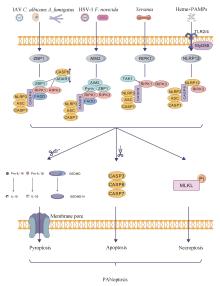
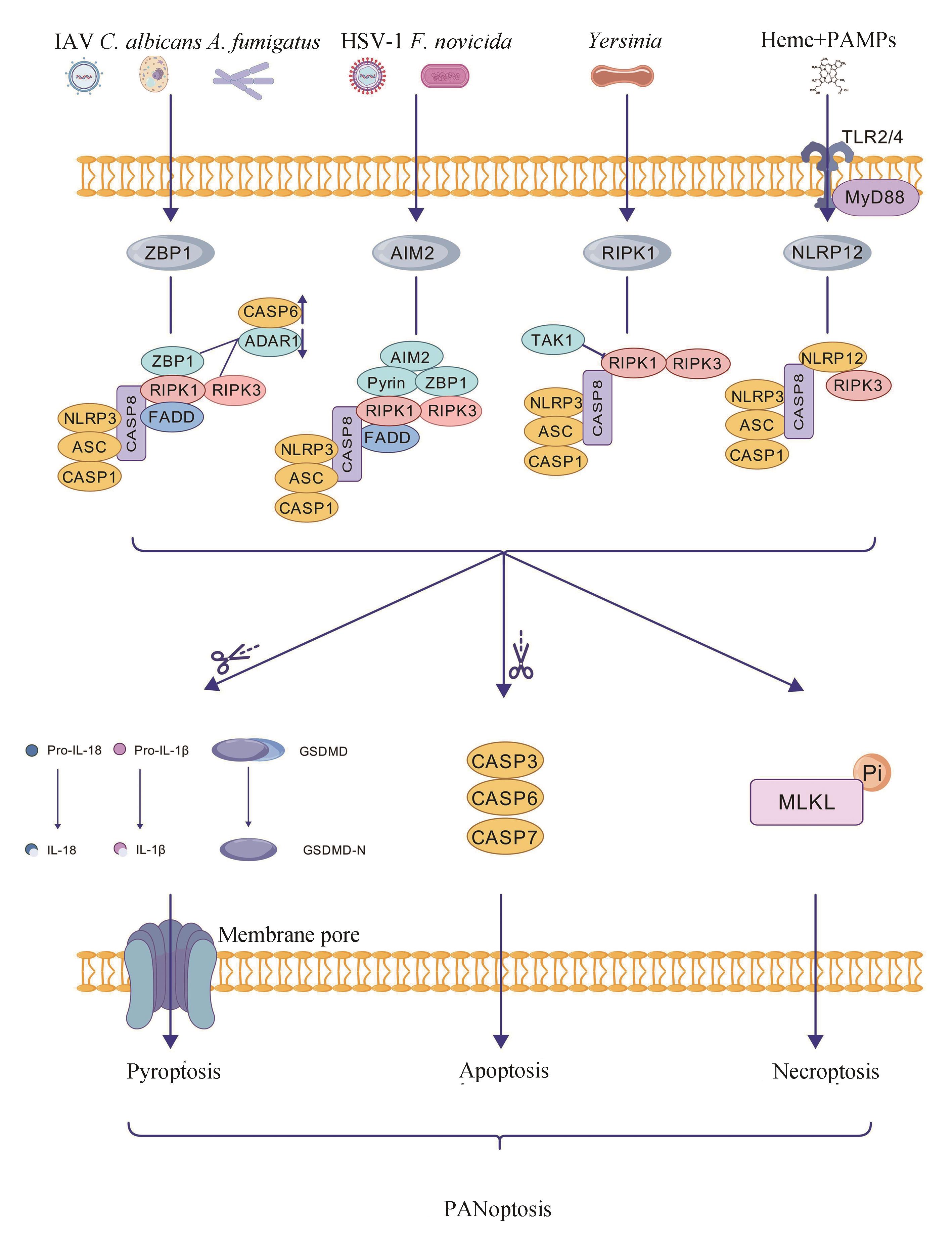
| [14] | Christgen S, Zheng M, Kesavardhana S, et al. Identification of the PANoptosome: a molecular platform triggering pyroptosis, apoptosis, and necroptosis (PANoptosis) [J]. Front Cell Infect Microbiol, 2020, 10: 237. |
| [15] | Jiang S, Li H, Zhang L, et al. Generic diagramming platform (GDP): a comprehensive database of high-quality biomedical graphics[J]. Nucleic Acids Res, 2025, 53(d1): D1670-D1676. |
| [16] | Kuriakose T, Kanneganti TD. ZBP1: innate sensor regulating cell death and inflammation[J]. Trends Immunol, 2018, 39(2): 123-134. |
| [17] | Kesavardhana S, Subbarao Malireddi RK, Burton AR, et al. The Zα2 domain of ZBP1 is a molecular switch regulating influenza-induced PANoptosis and perinatal lethality during development[J]. J Biol Chem, 2020, 295(24): 8325-8330. |
| [18] | Banoth B, Tuladhar S, Karki R, et al. ZBP1 promotes fungi-induced inflammasome activation and pyroptosis, apoptosis, and necroptosis (PANoptosis)[J]. J Biol Chem, 2020, 295(52): 18276-18283. |
| [19] | Zheng M, Karki R, Vogel P, et al. Caspase-6 is a key regulator of innate immunity, inflammasome activation, and host defense[J]. Cell, 2020, 181(3): 674-687.e13. |
| [20] | Karki R, Lee S, Mall R, et al. ZBP1-dependent inflammatory cell death, PANoptosis, and cytokine storm disrupt IFN therapeutic efficacy during coronavirus infection[J]. Sci Immunol, 2022, 7(74): eabo6294. |
| [21] | Lee S, Karki R, Wang YQ, et al. AIM2 forms a complex with pyrin and ZBP1 to drive PANoptosis and host defence[J]. Nature, 2021, 597(7876): 415-419. |
| [22] | Cuny GD, Degterev A. RIPK protein kinase family: atypical lives of typical kinases[J]. Semin Cell Dev Biol, 2021, 109: 96-105. |
| [23] | Subbarao Malireddi RK, Kesavardhana S, Karki R, et al. RIPK1 distinctly regulates Yersinia-induced inflammatory cell death, PANoptosis[J]. Immunohorizons, 2020, 4(12): 789-796. |
| [24] | Dillon CP, Weinlich R, Rodriguez DA, et al. RIPK1 blocks early postnatal lethality mediated by caspase-8 and RIPK3[J]. Cell, 2014, 157(5): 1189-1202. |
| [25] | Dannappel M, Vlantis K, Kumari S, et al. RIPK1 maintains epithelial homeostasis by inhibiting apoptosis and necroptosis[J]. Nature, 2014, 513(7516): 90-94. |
| [26] | Jin L, Chen J, Liu XY, et al. The double life of RIPK1[J]. Mol Cell Oncol, 2016, 3(1): e1035690. |
| [27] | Geng JF, Ito Y, Shi LY, et al. Regulation of RIPK1 activation by TAK1-mediated phosphorylation dictates apoptosis and necroptosis[J]. Nat Commun, 2017, 8(1): 359. |
| [28] | Subbarao Malireddi RK, Gurung P, Kesavardhana S, et al. Innate immune priming in the absence of TAK1 drives RIPK1 kinase activity-independent pyroptosis, apoptosis, necroptosis, and inflammatory disease[J]. J Exp Med, 2020, 217(3): jem.20191644. |
| [29] | Sundaram B, Pandian N, Mall R, et al. NLRP12-PANoptosome activates PANoptosis and pathology in response to heme and PAMPs[J]. Cell, 2023, 186(13): 2783-2801.e20. |
| [30] | Henkel FDR, O’Neill LAJ. NLRP12 drives PANoptosis in response to heme[J]. Trends Immunol, 2023, 44(8): 574-576. |
| [31] | Zhang AP, Zhang CC, Zhang YH, et al. PANoptosis is a compound death in periodontitis: a systematic review of ex vivo and in vivo studies[J]. Oral Dis, 2024, 30(4): 1828-1842. |
| [32] | Aral K, Aral CA, Kapila Y. The role of caspase-8, caspase-9, and apoptosis inducing factor in perio-dontal disease[J]. J Periodontol, 2019, 90(3): 288-294. |
| [33] | Shi J, Li J, Su W, et al. Loss of periodontal ligament fibroblasts by RIPK3-MLKL-mediated necroptosis in the progress of chronic periodontitis[J]. Sci Rep, 2019, 9(1): 2902. |
| [34] | Bugueno IM, Batool F, Korah L, et al. Porphyromonas gingivalis differentially modulates apoptosome apoptotic peptidase activating factor 1 in epithelial cells and fibroblasts[J]. Am J Pathol, 2018, 188(2): 404-416. |
| [35] | Li YY, Cai Q, Li BS, et al. The effect of Porphyromonas gingivalis lipopolysaccharide on the pyroptosis of gingival fibroblasts[J]. Inflammation, 2021, 44(3): 846-858. |
| [36] | Chen Q, Liu XG, Wang DY, et al. Periodontal inflammation-triggered by periodontal ligament stem cell pyroptosis exacerbates periodontitis[J]. Front Cell Dev Biol, 2021, 9: 663037. |
| [37] | Duan Y, An W, Wu YX, et al. Tetramethylpyrazine reduces inflammation levels and the apoptosis of LPS-stimulated human periodontal ligament cells via the downregulation of miR-302b[J]. Int J Mol Med, 2020, 45(6): 1918-1926. |
| [38] | Oka S, Li XY, Sato F, et al. A deficiency of Dec2 triggers periodontal inflammation and pyroptosis[J]. J Periodontal Res, 2021, 56(3): 492-500. |
| [39] | Sun DD, Wu X, Lin SC, et al. Anti-apoptosis and anti-inflammation activity of circ_0097010 downregulation in lipopolysaccharide-stimulated periodontal ligament cells by miR-769-5p/Krüppel like factor 6 axis[J]. J Dent Sci, 2023, 18(1): 310-321. |
| [40] | Yang YN, Wang LX, Zhang HB, et al. Mixed lineage kinase domain-like pseudokinase-mediated necroptosis aggravates periodontitis progression[J]. J Mol Med (Berl), 2022, 100(1): 77-86. |
| [41] | Ke XJ, Lei L, Li H, et al. Manipulation of necroptosis by Porphyromonas gingivalis in periodontitis development[J]. Mol Immunol, 2016, 77: 8-13. |
| [42] | Li J, Shi JH, Pan Y, et al. Transcription modulation by CDK9 regulates inflammatory genes and RIPK3-MLKL-mediated necroptosis in periodontitis progression[J]. Sci Rep, 2019, 9(1): 17369. |
| [43] | Zhang KY, Chen XX, Zhou R, et al. Inhibition of gingival fibroblast necroptosis mediated by RIPK3/MLKL attenuates periodontitis[J]. J Clin Periodontol, 2023, 50(9): 1264-1279. |
| [44] | Jiang WY, Deng ZL, Dai XZ, et al. PANoptosis: a new insight into oral infectious diseases[J]. Front Immunol, 2021, 12: 789610. |
| [45] | Tomalka J, Ganesan S, Azodi E, et al. A novel role for the NLRC4 inflammasome in mucosal defenses against the fungal pathogen Candida albicans [J]. PLoS Pathog, 2011, 7(12): e1002379. |
| [46] | Cao MT, Wu ZX, Lou Q, et al. Dectin-1-induced RIPK1 and RIPK3 activation protects host against Candida albicans infection[J]. Cell Death Differ, 2019, 26(12): 2622-2636. |
| [47] | Wang X, Li Y, Liu S, et al. Direct activation of RIP3/MLKL-dependent necrosis by herpes simplex virus 1 (HSV-1) protein ICP6 triggers host antiviral defense[J]. Proc Natl Acad Sci U S A, 2014, 111(43): 15438-15443. |
| [48] | Yu XL, Li Y, Chen Q, et al. Herpes simplex virus 1 (HSV-1) and HSV-2 mediate species-specific modulations of programmed necrosis through the viral ribonucleotide reductase large subunit R1[J]. J Virol, 2015, 90(2): 1088-1095. |
| [49] | Guo HY, Omoto S, Harris PA, et al. Herpes simplex virus suppresses necroptosis in human cells[J]. Cell Host Microbe, 2015, 17(2): 243-251. |
| [50] | Siqueira JF Jr, Rôças IN. Present status and future directions: microbiology of endodontic infections[J]. Int Endod J, 2022, 55(): 512-530. |
| [51] | Liu L, Liang LP, Yang CH, et al. Extracellular vesicles of Fusobacterium nucleatum compromise intestinal barrier through targeting RIPK1-mediated cell death pathway[J]. Gut Microbes, 2021, 13(1): 1-20. |
| [52] | Liu H, Liu YX, Fan W, et al. Fusobacterium nucleatum triggers proinflammatory cell death via Z-DNA binding protein 1 in apical periodontitis[J]. Cell Commun Signal, 2022, 20(1): 196. |
| [53] | Ran S, Chu M, Gu S, et al. Enterococcus faecalis induces apoptosis and pyroptosis of human osteoblastic MG63 cells via the NLRP3 inflammasome[J]. Int Endod J, 2019, 52(1): 44-53. |
| [54] | Dai X, Deng Z, Liang Y, et al. Enterococcus faecalis induces necroptosis in human osteoblastic MG63 cells through the RIPK3/MLKL signalling pathway[J]. Int Endod J, 2020, 53(9): 1204-1215. |
| [55] | Chi DL, Lin XW, Meng QZ, et al. Real-time induction of macrophage apoptosis, pyroptosis, and necro-ptosis by Enterococcus faecalis OG1RF and two root canal isolated strains[J]. Front Cell Infect Microbiol, 2021, 11: 720147. |
| [56] | Mall R, Bynigeri RR, Karki R, et al. Pancancer transcriptomic profiling identifies key PANoptosis mar-kers as therapeutic targets for oncology[J]. NAR Cancer, 2022, 4(4): zcac033. |
| [57] | Karki R, Sundaram B, Sharma BR, et al. ADAR1 restricts ZBP1-mediated immune response and PANoptosis to promote tumorigenesis[J]. Cell Rep, 2021, 37(3): 109858. |
| [58] | Subbarao Malireddi RK, Karki R, Sundaram B, et al. Inflammatory cell death, PANoptosis, mediated by cytokines in diverse cancer lineages inhibits tumor growth[J]. Immunohorizons, 2021, 5(7): 568-580. |
| [59] | Yang P, Huang GZ, Li YL, et al. Identification of PANoptosis-related biomarkers and analysis of prognostic values in head and neck squamous cell carcinoma[J]. Sci Rep, 2024, 14(1): 9824. |
| [60] | Gao F, Zhang MH, Ying ZG, et al. A PANoptosis pattern to predict prognosis and immunotherapy response in head and neck squamous cell carcinoma[J]. Heliyon, 2024, 10(5): e27162. |
| [61] | Jiang XY, Fu TT, Huang L. PANoptosis: a new insight for oral diseases[J]. Mol Biol Rep, 2024, 51(1): 960. |
| [1] | Hongyue Shang,Tiejun Liu,Manman Yao,Yueting Lu,Bo Dong,Weijing Song,Ji’ao Zhang. A Mendelian randomization study of programmed cell death ligand 1 with the risk of head and neck cancer [J]. Int J Stomatol, 2026, 53(1): 67-75. |
| [2] | Xing Wu,Yuping Liu,Yifan Zhang,Yucong Xia,Zhaohe Li,Xiaowei Yi,Hong Xia,Wenwen Ding. Research progress on the regulatory mechanism and prevention and treatment of proanthocyanidins in oral diseases [J]. Int J Stomatol, 2025, 52(5): 644-654. |
| [3] | Nanyang Zhao,Juanjuan Wu,Zhou Zhou,Xinyue Chen,Xutong Zhang,Yifei Xu,Taiming Dai. Oral health status of 12-year-old children in the areas and non-intervention areas of comprehensive intervention project for pediatric oral diseases in Guizhou Province [J]. Int J Stomatol, 2025, 52(4): 484-489. |
| [4] | Qihang Huang,Hang Wang,Yaozhong Wang,Dechao Li. Application of electrospun nanofibers in maxillofacial tissue repair [J]. Int J Stomatol, 2025, 52(4): 526-533. |
| [5] | Fu Yu, He Wei, Huang Lan. Ferroptosis and its implication in oral diseases [J]. Int J Stomatol, 2024, 51(1): 36-44. |
| [6] | Yang Qianjuan,Song Zhixin,Fang Shishu,Gu Zexu,Jin Zuolin,Liu Qian. New advances in oral diseases based on salivary metabolomics [J]. Int J Stomatol, 2023, 50(3): 321-328. |
| [7] | Chen Yifei,Zhang Binjing,Feng Shuqi,Xu Rui,Yang Shuxian,Li Yuqing. Effects of flavonoids on oral microorganisms and its mechanism [J]. Int J Stomatol, 2023, 50(2): 210-216. |
| [8] | Liu Qianxi,Wu Jiayi,Ren Biao,Huang Ruijie. Research progress on the interactions between Enterococcus faecalis and other oral microorganisms [J]. Int J Stomatol, 2022, 49(3): 290-295. |
| [9] | Chen Jing,Ge Ziyu,Yu Tingting,Zhang Yanzhen. Research progress on the correlation between Parkinson's disease and oral diseases [J]. Int J Stomatol, 2021, 48(2): 218-224. |
| [10] | Yi Zumu,Wang Xinyu,Wu Yingying. Bacterial diversity of oral flora in patients with diabetes [J]. Int J Stomatol, 2020, 47(5): 522-529. |
| [11] | Hu Yao,Cheng Lei,Guo Qiang,Ren Biao. Research progress on cross-kingdom interactions between Candida albicans and common oral bacteria [J]. Int J Stomatol, 2019, 46(6): 663-669. |
| [12] | Jiang Xue,Huang Danyuan,Liao Wen. Advances in KTiOPO4 laser for oral disease treatment [J]. Int J Stomatol, 2019, 46(4): 456-462. |
| [13] | Wei Li,Jinglin Zhou. Research on oral metabonomics [J]. Int J Stomatol, 2019, 46(3): 249-252. |
| [14] | Donglei Wu,Jing Liu. Research progress on the association between oxidative stress injury and certain oral diseases [J]. Inter J Stomatol, 2019, 46(1): 62-67. |
| [15] | Yan Tao,Yu Zhou,Qianming. Chen. Research progress on oral manifestations of vitamin B12 deficiency [J]. Inter J Stomatol, 2019, 46(1): 78-83. |
|
||