国际口腔医学杂志 ›› 2026, Vol. 53 ›› Issue (6): 866-873.doi: 10.7518/gjkq.2026601
• 综述 • 上一篇
张可宜( ),周婕妤,吴亚菲()
Keyi Zhang(),Jieyu Zhou,Yafei Wu()
摘要:
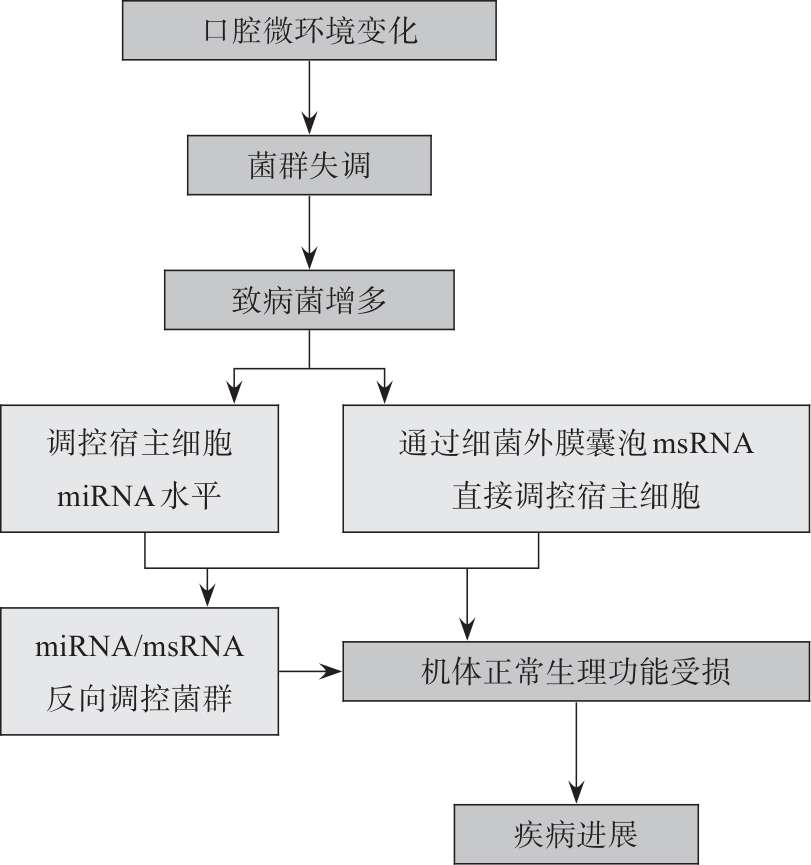
人类口腔栖息着高度复杂的微生物群,其组成与功能的动态平衡是维系口腔健康的核心因素。口腔共生微生物是自然状态下存在于人口腔中,与机体互利共生的微生物群,当宿主和环境因素发生改变时,则可能出现菌群失调,参与牙周炎、口腔癌等多种口腔疾病的病理进程。微小RNA(miRNA)作为基因表达的转录后调控因子,可介导微生物—宿主双向交互的调控作用。本研究总结并探讨口腔菌群失调与miRNA在典型口腔疾病中的分子调节机制,并对基于miRNA的益生菌治疗口腔疾病的进展进行回顾与展望。
中图分类号:
| [1] | Radaic A, Kapila YL. The oralome and its dysbiosis: new insights into oral microbiome-host inte-ractions[J]. Comput Struct Biotechnol J, 2021, 19: 1335-1360. |
| [2] | Zaura E, Keijser BJ, Huse SM, et al. Defining the healthy “core microbiome” of oral microbial communities[J]. BMC Microbiol, 2009, 9(1): 259. |
| [3] | Caballero-Flores G, Pickard JM, Núñez G. Micro-biota-mediated colonization resistance: mechanisms and regulation[J]. Nat Rev Microbiol, 2023, 21(6): 347-360. |
| [4] | Sedghi L, DiMassa V, Harrington A, et al. The oral microbiome: role of key organisms and complex networks in oral health and disease[J]. Periodontol 2000, 2021, 87(1): 107-131. |
| [5] | Hou KJ, Wu ZX, Chen XY, et al. Microbiota in health and diseases[J]. Sig Transduct Target Ther, 2022, 7: 135. |
| [6] | Shang RF, Lee S, Senavirathne G, et al. MicroRNAs in action: biogenesis, function and regulation[J]. Nat Rev Genet, 2023, 24(12): 816-833. |
| [7] | Luan XH, Zhou XF, Fallah P, et al. MicroRNAs: harbingers and shapers of periodontal inflammation[J]. Semin Cell Dev Biol, 2022, 124: 85-98. |
| [8] | Tubero Euzebio Alves V, Al-Attar A, Alimova Y, et al. Streptococcus gordonii-induced miRNAs regula-te CCL20 responses in human oral epithelial cells[J]. Infect Immun, 2022, 90(3): e0058621. |
| [9] | Socransky SS, Haffajee AD, Cugini MA, et al. Microbial complexes in subgingival plaque[J]. J Clin Periodontol, 1998, 25(2): 134-144. |
| [10] | Lee YH, Na HS, Jeong SY, et al. Comparison of inflammatory microRNA expression in healthy and periodontitis tissues[J]. Biocell, 2011, 35(2): 43-49. |
| [11] | Du AQ, Zhao S, Wan LY, et al. MicroRNA expression profile of human periodontal ligament cells under the influence of Porphyromonas gingivalis LPS[J]. J Cell Mol Med, 2016, 20(7): 1329-1338. |
| [12] | Benakanakere MR, Li QY, Eskan MA, et al. Modulation of TLR2 protein expression by miR-105 in human oral keratinocytes[J]. J Biol Chem, 2009, 284(34): 23107-23115. |
| [13] | Na HS, Park MH, Song YR, et al. Elevated Micro-RNA-128 in periodontitis mitigates tumor necrosis factor-α response via p38 signaling pathway in ma-crophages[J]. J Periodontol, 2016, 87(9): e173-e182. |
| [14] | Moffatt CE, Lamont RJ. Porphyromonas gingivalis induction of MicroRNA-203 expression controls suppressor of cytokine signaling 3 in gingival epithelial cells[J]. Infect Immun, 2011, 79(7): 2632-2637. |
| [15] | Ragusa M, Santagati M, Mirabella F, et al. Potential associations among alteration of salivary miRNAs, saliva microbiome structure, and cognitive impairments in autistic children[J]. Int J Mol Sci, 2020, 21(17): 6203. |
| [16] | Aravindraja C, Jeepipalli S, Vekariya KM, et al. Oral spirochete treponema denticola intraoral infection reveals unique miR-133a, miR-486, miR-126-3p, miR-126-5p miRNA expression kinetics during periodontitis[J]. Int J Mol Sci, 2023, 24(15): 12105. |
| [17] | Mahendra J, Mahendra L, Fageeh HN, et al. Mi-RNA-146a and miRNA-126 as potential biomarkers in patients with coronary artery disease and genera-lized periodontitis[J]. Materials, 2021, 14(16): 4692. |
| [18] | Mutha NVR, Mohammed WK, Krasnogor N, et al. Transcriptional responses of Streptococcus gordonii and Fusobacterium nucleatum to coaggregation[J]. Mol Oral Microbiol, 2018, 33(6): 450-464. |
| [19] | Aravindraja C, Kashef MR, Vekariya KM, et al. Global noncoding microRNA profiling in mice infected with partial human mouth microbes (PAH-MM) using an ecological time-sequential polybacterial periodontal infection (ETSPPI) model reveals sex-specific differential microRNA expression[J]. Int J Mol Sci, 2022, 23(9): 5107. |
| [20] | Nagasawa Y, Misaki T, Ito S, et al. Iga nephropathy and oral bacterial species related to dental caries and periodontitis[J]. Int J Mol Sci, 2022, 23(2): 725. |
| [21] | Du LL, Chen X, Duan ZM, et al. MiR-146a negatively regulates dectin-1-induced inflammatory responses[J]. Oncotarget, 2017, 8(23): 37355-37366. |
| [22] | Monk CE, Hutvagner G, Arthur JSC. Regulation of miRNA transcription in macrophages in response to Candida albicans [J]. PLoS One, 2010, 5(10): e13669. |
| [23] | Horváth M, Nagy G, Zsindely N, et al. Oral epithe-lial cells distinguish between candida species with high or low pathogenic potential through MicroRNA regulation[J]. mSystems, 2021, 6(3): e00163-21. |
| [24] | Bishop DG, Work E. An extracellular glycolipid produced by Escherichia coli grown under lysine-limi-ting conditions[J]. Biochem J, 1965, 96(2): 567-576. |
| [25] | Lee HJ, Hong SH. Analysis of microRNA-size, small RNAs in Streptococcus mutans by deep sequencing[J]. FEMS Microbiol Lett, 2012, 326(2): 131-136. |
| [26] | Kang SM, Choi JW, Lee Y, et al. Identification of microRNA-size, small RNAs in Escherichia coli [J]. Curr Microbiol, 2013, 67(5): 609-613. |
| [27] | Choi JW, Kim SC, Hong SH, et al. Secretable small RNAs via outer membrane vesicles in periodontal pathogens[J]. J Dent Res, 2017, 96(4): 458-466. |
| [28] | Han EC, Choi SY, Lee Y, et al. Extracellular RNAs in periodontopathogenic outer membrane vesicles promote TNF-α production in human macrophages and cross the blood-brain barrier in mice[J]. FASEB J, 2019, 33(12): 13412-13422. |
| [29] | Drummond IY, DePaolo A, Krieger M, et al. Small regulatory RNAs are mediators of the Streptococcus mutans SloR regulon[J]. J Bacteriol, 2023, 205(9): e0017223. |
| [30] | Choi JW, Kwon TY, Hong SH, et al. Isolation and characterization of a microRNA-size secretable small RNA in Streptococcus sanguinis [J]. Cell Biochem Biophys, 2018, 76(1/2): 293-301. |
| [31] | Yuan C, Burns MB, Subramanian S, et al. Interaction between host microRNAs and the gut microbiota in colorectal cancer[J]. mSystems, 2018, 3(3): e00205-17. |
| [32] | Kozomara A, Griffiths-Jones S. miRBase: annota-ting high confidence microRNAs using deep sequencing data[J]. Nucleic Acids Res, 2014, 42(D1): D68-D73. |
| [33] | Liu SR, da Cunha AP, Rezende RM, et al. The host shapes the gut microbiota via fecal MicroRNA[J]. Cell Host Microbe, 2016, 19(1): 32-43. |
| [34] | Xie YF, Sun MJ, Xia YR, et al. An RNA-seq screen of P. gingivalis LPS treated human gingival fibroblasts[J]. Arch Oral Biol, 2018, 88: 77-84. |
| [35] | Jiang SY, Xue D, Xie YF, et al. The negative feedback regulation of microRNA-146a in human perio-dontal ligament cells after Porphyromonas gingivalis lipopolysaccharide stimulation[J]. Inflamm Res, 2015, 64(6): 441-451. |
| [36] | Li W, Wang JW, Hao WJ, et al. MicroRNA-543-3p down-regulates inflammation and inhibits periodontitis through KLF6[J]. Biosci Rep, 2021, 41(5): BSR20210138. |
| [37] | Uttamani JR, Naqvi AR, Estepa AMV, et al. Downregulation of miRNA-26 in chronic periodontitis interferes with innate immune responses and cell migration by targeting phospholipase C beta 1[J]. J Clin Periodontol, 2023, 50(1): 102-113. |
| [38] | Xia Y, Cheng T, Zhang C, et al. Human bone marrow mesenchymal stem cell-derived extracellular vesicles restore Th17/Treg homeostasis in perio-dontitis via miR-1246[J]. FASEB J, 2023, 37(11): e23226. |
| [39] | Nandipati SR, Appukuttan D, Subramanian S, et al. Role of miRNA-155 in the regulation of osteoclast differentiation mediated by MITF in stage Ⅲ/Ⅳ pe-riodontitis: a case-control study[J]. J Genet Eng Biotechnol, 2022, 20(1): 161. |
| [40] | Deng WJ, Wang XL, Zhang J, et al. Circ_0138959/miR-495-3p/TRAF6 axis regulates proliferation, wound healing and osteoblastic differentiation of periodontal ligament cells in periodontitis[J]. J Dent Sci, 2022, 17(3): 1125-1134. |
| [41] | Li ZR, Fu R, Wen XT, et al. Network analysis reveals miRNA crosstalk between periodontitis and oral squamous cell carcinoma[J]. BMC Oral Heal-th, 2023, 23: 19. |
| [42] | Yang YT, Sun XL, Li MH, et al. MiR-214 modulates the growth and migration of oral cancer before and after chemotherapy through mediating ULK1[J]. J Immunol Res, 2022, 2022: 4589182. |
| [43] | Wang H, Wang L, Zhou XC, et al. OSCC exosomes regulate miR-210-3p targeting EFNA3 to promote oral cancer angiogenesis through the PI3K/AKT pathway[J]. Biomed Res Int, 2020, 2020: 2125656. |
| [44] | Xia HF, Wang XL, Zhang HJ, et al. PCBP2-dependent secretion of miRNAs via extracellular vesicles contributes to the EGFR-driven angiogenesis[J]. Theranostics, 2025, 15(4): 1255-1271. |
| [45] | Liu DK, Yu S, Li JP, et al. MiR-150 suppressed cell viability, invasion and EMT via HMGA2 in oral squamous cell carcinoma[J]. Eur Rev Med Pharmacol Sci, 2021, 25(11): 3981-3989. |
| [46] | Milan TM, Silva G, Sousa LO, et al. Sphingosine kinase 2 controls the aggressive phenotype of oral squamous cell carcinoma by regulating miR-205 and miR-296 through p53[J]. Am J Pathol, 2025, 195(2): 321-333. |
| [47] | Jaksic Karisik M, Lazarevic M, Mitic D, et al. MicroRNA-21 as a regulator of cancer stem cell pro-perties in oral cancer[J]. Cells, 2025, 14(2): 91. |
| [48] | Zhong S, Zhang SP, Bair E, et al. Differential expression of MicroRNAs in normal and inflamed human pulps[J]. J Endod, 2012, 38(6): 746-752. |
| [49] | Hui T, Wang C, Chen D, et al. Epigenetic regulation in dental pulp inflammation[J]. Oral Dis, 2017, 23(1): 22-28. |
| [50] | Nara K, Kawashima N, Noda S, et al. Anti-inflammatory roles of microRNA 21 in lipopolysaccharide-stimulated human dental pulp cells[J]. J Cell Phy-siol, 2019, 234(11): 21331-21341. |
| [51] | Shen Z, Wichnieski C, Carneiro E, et al. Expression profiling and functional characterization of Micro-RNAs in apical periodontitis[J]. J Endod, 2021, 47(2): 263-271. |
| [52] | Li MW, Wei LF, Zhou W, et al. MiR-200a contri-butes to the migration of BMSCs induced by the secretions of E. faecalis via FOXJ1/NFκB/MMPs axis[J]. Stem Cell Res Ther, 2020, 11: 317. |
| [53] | Hu J, Huang X, Zheng LW, et al. MiR-199a-5P promotes osteogenic differentiation of human stem cells from apical papilla via targeting IFIT2 in apical periodontitis[J]. Front Immunol, 2023, 14: 1149339. |
| [54] | Sayed NH, Shaker OG, Abd‑Elmawla MA, et al. New insights into the interplay between MALAT1 and miRNA-155 to unravel potential diagnostic and prognostic biomarkers of Behçet’s disease[J]. Clin Rheumatol, 2025, 44(2): 775-787. |
| [55] | Tao YG, Xie CQ, Zhong L, et al. Exosomal miR-17-5p derived from epithelial cells is involved in aberrant epithelium-fibroblast crosstalk and induces the development of oral submucosal fibrosis[J]. Int J Oral Sci, 2024, 16: 48. |
| [56] | Wen DD, Zhang HM, Zhou YT, et al. MicroRNA-503 suppresses oral mucosal fibroblast differentiation by regulating RAS/RAF/MEK/ERK signaling pathway[J]. Biomolecules, 2024, 14(10): 1259. |
| [57] | Wang J, Hu MY, Li LL. Clinical values of miR-23a-3p in oral lichen planus and its role in keratinocyte proliferation and inflammatory response[J]. J Inflamm Res, 2021, 14: 5013-5021. |
| [58] | Morelli L, Capurso L. FAO/WHO guidelines on probiotics[J]. J Clin Gastroenterol, 2012, 46(): S1-S2. |
| [59] | Mishra SP, Wang B, Jain S, et al. A mechanism by which gut microbiota elevates permeability and inflammation in obese/diabetic mice and human gut[J]. Gut, 2023, 72(10): 1848-1865. |
| [60] | Behera J, Ison J, Voor MJ, et al. Probiotics stimulate bone formation in obese mice via histone methy-lations[J]. Theranostics, 2021, 11(17): 8605-8623. |
| [61] | Kalani M, Hodjati H, Sajedi Khanian M, et al. Lactobacillus acidophilus increases the anti-apoptotic Micro RNA-21 and decreases the pro-inflammatory Micro RNA-155 in the LPS-treated human endothelial cells[J]. Probiotics Antimicrob Proteins, 2016, 8(2): 61-72. |
| [62] | Giahi L, Aumueller E, Elmadfa I, et al. Regulation of TLR4, p38 MAPkinase, IκB and miRNAs by inactivated strains of lactobacilli in human dendritic cells[J]. Benef Microbes, 2012, 3(2): 91-98. |
| [63] | Han X, Zhang J, Tan YQ, et al. Probiotics: a non-conventional therapy for oral lichen planus[J]. Arch Oral Biol, 2017, 81: 90-96. |
| [1] | 赵晨蕾,郭杰,靳琳玉,李松,庄志征,仇永乐. circFNDC3B调控微小RNA-206/膜联蛋白A2通路对口腔鳞状细胞癌SCC-9细胞生物学行为的影响[J]. 国际口腔医学杂志, 2026, 53(6): 833-841. |
| [2] | 叶兴如,左玉,马玉. 光动力疗法和全身抗菌药物辅助治疗Ⅲ期或Ⅳ期牙周炎合并2型糖尿病患者的临床疗效比较[J]. 国际口腔医学杂志, 2026, 53(6): 850-858. |
| [3] | 舒路红,李航基雲,张婷,赵艳,崔古贞,洪伟,廖健. 植物乳杆菌‑SLH对实验性牙周炎的治疗效果评价[J]. 国际口腔医学杂志, 2026, 53(4): 513-525. |
| [4] | 张欣,袁梦,岳玉凤,段小燕. 应对方式在口腔癌患者创伤后成长与癌症复发恐惧间的中介效应分析[J]. 国际口腔医学杂志, 2026, 53(4): 545-553. |
| [5] | 刘熠,潘亚萍. 牙槽骨角形吸收的危险因素研究进展[J]. 国际口腔医学杂志, 2026, 53(3): 362-369. |
| [6] | 吴子湘,谭碧云,湛晶蕾,李霞,葛颂. 细胞焦亡参与牙龈卟啉单胞菌促进动脉粥样硬化发生发展的研究进展[J]. 国际口腔医学杂志, 2026, 53(3): 370-380. |
| [7] | 郭文迪,齐鲁,王星. 微小RNA-143/145基因簇在口腔鳞状细胞癌细胞信号通路调控中作用的研究进展[J]. 国际口腔医学杂志, 2026, 53(3): 441-448. |
| [8] | 郭怡婧,杜思雨,陈亚冰,王雷. 辛伐他汀前药在牙周炎治疗中的研究进展[J]. 国际口腔医学杂志, 2026, 53(2): 239-246. |
| [9] | 陈可儿,包佳琦,孙伟莲. 颊壁形态影响牙周炎位点牙槽嵴保存的应用进展[J]. 国际口腔医学杂志, 2026, 53(1): 84-90. |
| [10] | 石琦企,秦旭,朱光勋. 铜死亡在牙周炎中的研究进展[J]. 国际口腔医学杂志, 2026, 53(1): 91-97. |
| [11] | 王诗雅,袁国华,邹静. 异位釉质的形成机制及临床诊疗策略[J]. 国际口腔医学杂志, 2025, 52(6): 713-721. |
| [12] | 陈禹黄,梁星,李然. 牙周炎患者缺失牙修复的临床考量及预后评估[J]. 国际口腔医学杂志, 2025, 52(6): 823-831. |
| [13] | 陈玉,雷银富,吴和梅,杜福兰,党洁,陈永梅,陶明,石兴莲. 口腔癌游离皮瓣重建患者气管切开术后肺炎风险预测模型的构建[J]. 国际口腔医学杂志, 2025, 52(5): 634-643. |
| [14] | 朱然,严静,孙卫斌,吴文蕾,刘玉. 服用抗血栓药物患者牙周基础治疗期间的出血风险管理[J]. 国际口腔医学杂志, 2025, 52(5): 670-676. |
| [15] | 李欢,原韶钟. 牙周炎与非酒精性脂肪性肝病相关性的研究进展[J]. 国际口腔医学杂志, 2025, 52(5): 677-683. |
|