国际口腔医学杂志 ›› 2026, Vol. 53 ›› Issue (2): 197-204.doi: 10.7518/gjkq.2026217
• 论著 • 上一篇
何林峰( ),刘飞,沈颉飞()
Linfeng He(),Fei Liu,Jiefei Shen()
摘要:
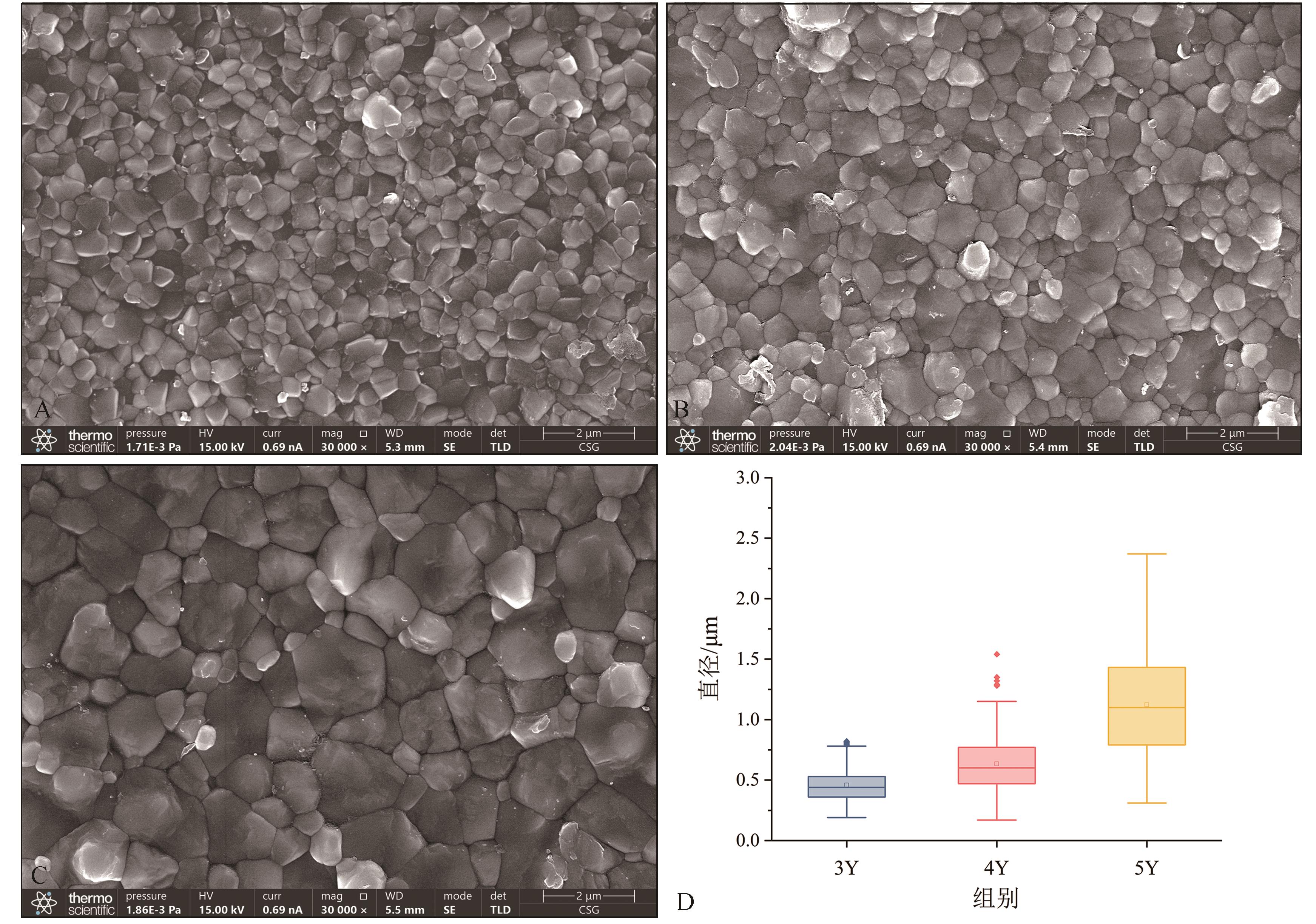
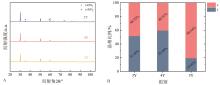
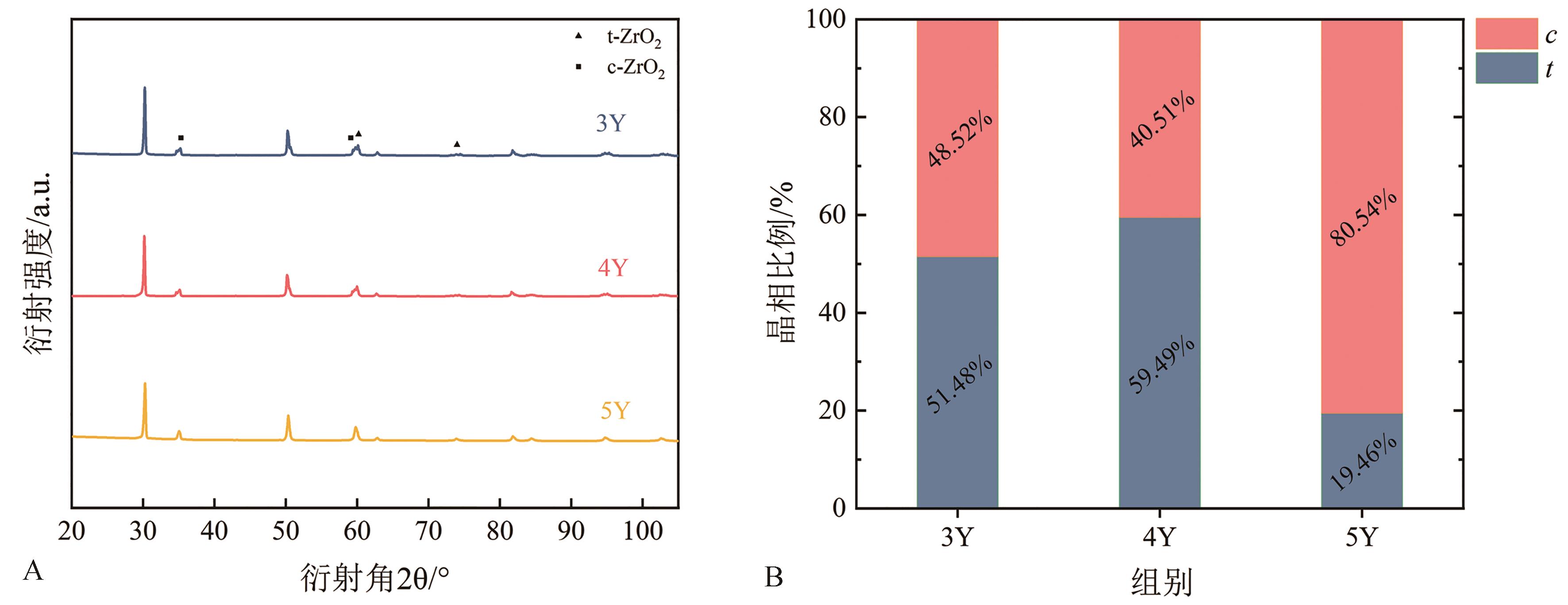
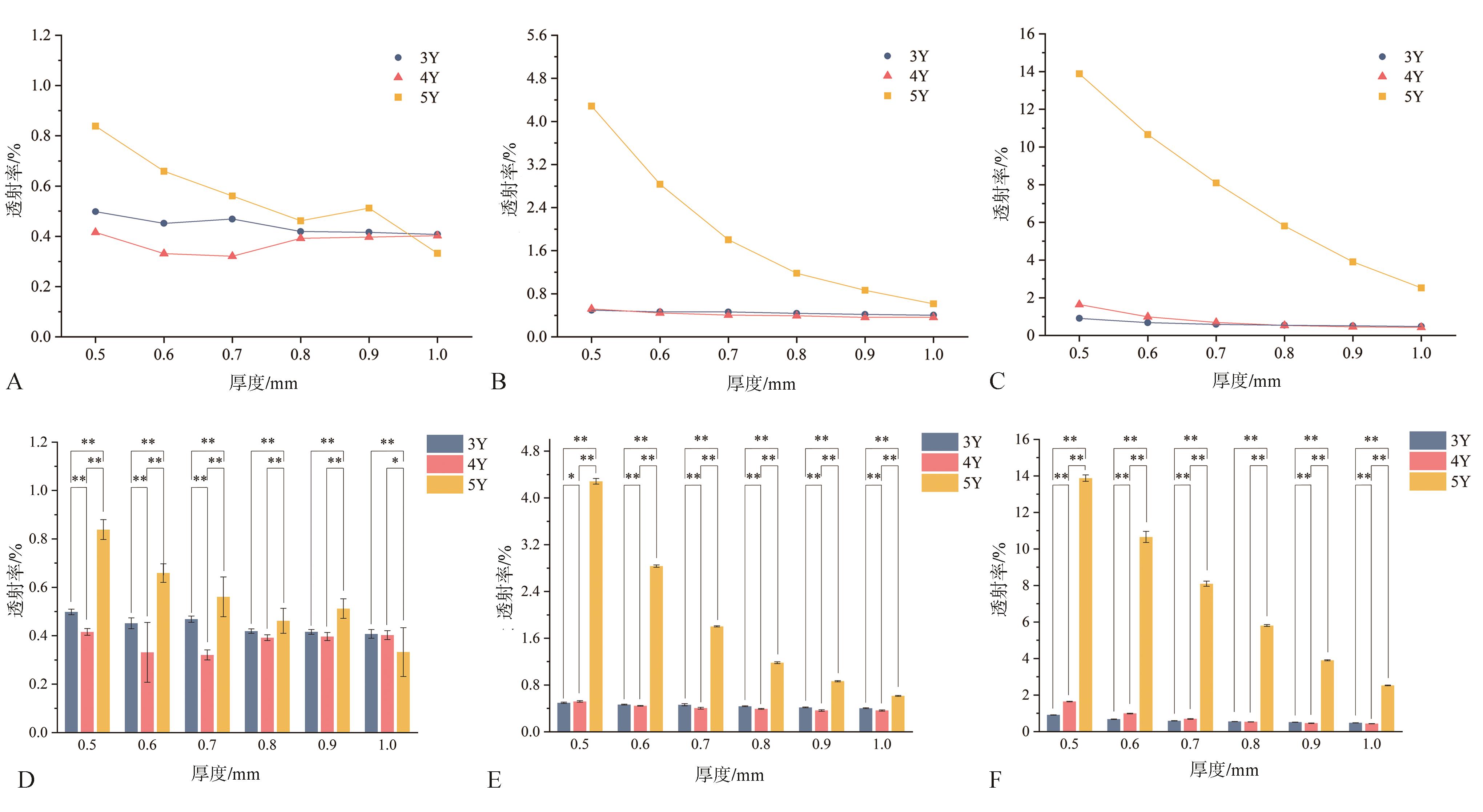
目的 探究氧化钇添加量对氧化锆的微观结构变化和光学性能的影响。 方法 选择同一品牌的氧化锆材料,分别添加3 mol%(3Y)、4 mol%(4Y)和5 mol%(5Y)的氧化钇预烧结盘,完成样品规格设计、切削和致密化烧结。用于材料微观结构表征的陶瓷样品,烧结后为直径9 mm,厚2 mm的圆片;用于材料的光学性能表征的陶瓷样品,烧结后为6 mm×8 mm、厚0.5~1.0 mm等厚度间隔的方片,共6组(n=5)。使用扫描电子显微镜技术表征材料表面形貌,X射线衍射技术表征材料的晶相结构;使用椭圆偏振仪表征材料的折射率,光谱仪表征材料的透射率和对比度(CR值)。 结果 氧化钇添加量增加,晶体直径增加;四方相比例在4Y组最高(59.49%),5Y组最低(19.46%)。随着氧化钇添加量增加,折射率降低。透射率受到波长和材料厚度显著影响,同一材料的透射率在长波段(705 nm)最高,短波段(435 nm)最低。3Y组与4Y组的透射率小于1%,5Y组的透射率在短波段(435 nm)低于1%,在长波段(705 nm)最高超过10%。CR值受材料厚度的影响较小,3Y和4Y的CR值为0.8±0.1,仅个别组之间的差异有统计学意义;5Y组的CR值为0.4±0.2,与其他两组差异均有统计学意义。 结论 氧化钇添加量较低时,主要促进四方相晶体的生长;而氧化钇添加量较高时,则显著促进立方相晶体的生长。氧化钇的添加量提高到5 mol%时,才能有效提高氧化锆的半透性。
中图分类号:
| [1] | Denry I, Kelly JR. State of the art of zirconia for dental applications[J]. Dent Mater, 2008, 24(3): 299-307. |
| [2] | Han MK. Advances and challenges in zirconia-based materials for dental applications[J]. J Korean Ceram Soc, 2024, 61(5): 783-799. |
| [3] | Uasuwan P, Juntavee N, Juntavee A. Flexural strength of novel glass infiltrated monochrome and multilayer high yttrium oxide containing zirconia upon various sintered cooling rates[J]. J Prosthodont, 2024, 33(S1): 47-59. |
| [4] | Reale Reyes A, Dennison JB, Powers JM, et al. Translucency and flexural strength of translucent zirconia ceramics[J]. J Prosthet Dent, 2023, 129(4): 644-649. |
| [5] | Mao L, Kaizer MR, Zhao M, et al. Graded ultra-translucent zirconia (5Y-PSZ) for strength and functionalities[J]. J Dent Res, 2018, 97(11): 1222-1228. |
| [6] | Zhang F, Inokoshi M, Batuk M, et al. Strength, toughness and aging stability of highly-translucent Y-TZP ceramics for dental restorations[J]. Dent Mater, 2016, 32(12): e327-e337. |
| [7] | Zhang Y, Lawn BR. Novel zirconia materials in dentistry[J]. J Dent Res, 2018, 97(2): 140-147. |
| [8] | 万乾炳. 口腔氧化锆修复材料分代之我见[J]. 国际口腔医学杂志, 2021, 48(2): 125-128. |
| Wan QB. My opinion on the generations of dental zirconia materials[J]. Int J Stomatol, 2021, 48(2): 125-128. | |
| [9] | Wang L, Wang K, Sheng Y, et al. The effect of phase contents on the properties of yttria stabilized zirconia dental materials fabricated by stereolitho-graphy-based additive manufacturing[J]. J Mech Behav Biomed Mater, 2024, 150: 106313. |
| [10] | Pabst W, Hostaša J. A closed-form expression approximating the mie solution for the real-in-line transmission of ceramics with spherical inclusions or pores[J]. Ceramics-Silikáty, 2013, 57(2): 151-161. |
| [11] | Pabst W, Hříbalová S. Light scattering models for describing the transmittance of transparent and translucent alumina and zirconia ceramics[J]. J Eur Ceram Soc, 2021, 41(3): 2058-2075. |
| [12] | Jiang L, Liao YM, Wan QB, et al. Effects of sinte-ring temperature and particle size on the translucency of zirconium dioxide dental ceramic[J]. J Mater Sci Mater Med, 2011, 22(11): 2429-2435. |
| [13] | Sen N, Sermet IB, Cinar S. Effect of coloring and sintering on the translucency and biaxial strength of monolithic zirconia[J]. J Prosthet Dent, 2018, 119(2): 308.e1-308.e7. |
| [14] | Zhang F, Vanmeensel K, Batuk M, et al. Highly-translucent, strong and aging-resistant 3Y-TZP ceramics for dental restoration by grain boundary se-gregation[J]. Acta Biomater, 2015, 16: 215-222. |
| [15] | Vult von Steyern P, Bruzell E, Vos L, et al. Sintering temperature accuracy and its effect on translucent yttria-stabilized zirconia: flexural strength, crystal structure, tetragonality and light transmission[J]. Dent Mater, 2022, 38(7): 1099-1107. |
| [16] | Miyagawa Y, Powers JM, O’Brien WJ. Optical pro-perties of direct restorative materials[J]. J Dent Res, 1981, 60(5): 890-894. |
| [17] | Alshahrani AM, Lim CH, Wolff MS, et al. Current speed sintering and high-speed sintering protocols compromise the translucency but not strength of yttria-stabilized zirconia[J]. Dent Mater, 2024, 40(4): 664-673. |
| [18] | Elsaka SE. Optical and mechanical properties of newly developed monolithic multilayer zirconia[J]. J Prosthodont, 2019, 28(1): e279-e284. |
| [19] | Shahmiri R, Standard OC, Hart JN, et al. Optical properties of zirconia ceramics for esthetic dental restorations: a systematic review[J]. J Prosthet Dent, 2018, 119(1): 36-46. |
| [20] | Vasylkiv O, Sakka Y, Skorokhod VV. Hardness and fracture toughness of alumina-doped tetragonal zirconia with different yttria contents[J]. Mater Trans, 2003, 44(10): 2235-2238. |
| [21] | Doğru G, Yılmaz H. Influence of low-temperature degradation on phase transformation and biaxial flexural strength on different high-translucent 4Y-PSZ, 5Y-PSZ, 6Y-PSZ monolithic zirconia[J]. Clin Exp Health Sci, 2024, 14(1): 45-53. |
| [22] | Hříbalová S, Pabst W. Modeling light scattering by spherical pores for calculating the transmittance of transparent ceramics-All you need to know[J]. J Eur Ceram Soc, 2021, 41(4): 2169-2192. |
| [23] | Ebeid K, Wille S, Hamdy A, et al. Effect of changes in sintering parameters on monolithic translucent zirconia[J]. Dent Mater, 2014, 30(12): e419-e424. |
| [24] | Kim MJ, Ahn JS, Kim JH, et al. Effects of the sinte-ring conditions of dental zirconia ceramics on the grain size and translucency[J]. J Adv Prosthodont, 2013, 5(2): 161-166. |
| [25] | Tuncel İ, Turp I, Üşümez A. Evaluation of translucency of monolithic zirconia and framework zirconia materials[J]. J Adv Prosthodont, 2016, 8(3): 181-186. |
| [26] | Ban S. Reliability and properties of core materials for all-ceramic dental restorations[J]. Jpn Dent Sci Rev, 2008, 44(1): 3-21. |
| [27] | Zhang Y. Making yttria-stabilized tetragonal zirconia translucent[J]. Dent Mater, 2014, 30(10): 1195-1203. |
| [28] | Hammoudeh H, Carracho L, Beard C, et al. Effect of different surface and heat treatments on the surface roughness, crystallography, and phase composition of high translucency zirconia for monolithic restorations[J]. J Prosthet Dent, 2024, 131(1): 164.e1-164.e11. |
| [1] | 余杰, 刘劲松. 氧化锆种植体的表面修饰及其对骨整合的影响[J]. 国际口腔医学杂志, 2025, 52(3): 281-295. |
| [2] | 黄博,王剑,张鑫. 口腔修复中氧化锆陶瓷低温老化的评估及解决策略[J]. 国际口腔医学杂志, 2025, 52(2): 169-175. |
| [3] | 姚雪敏,王华,王璐,赵彬. 口腔半透明氧化锆陶瓷粘接效果的影响因素[J]. 国际口腔医学杂志, 2024, 51(4): 450-455. |
| [4] | 曾芳,王剑. 全锆冠美学修复效果的影响因素[J]. 国际口腔医学杂志, 2022, 49(2): 233-238. |
| [5] | 杨光美,王剑. 全锆冠机械性能的研究现状及与临床应用的关系[J]. 国际口腔医学杂志, 2022, 49(1): 79-84. |
| [6] | 黎敏,华成舸,蒋丽. 提高氧化锆陶瓷粘接性能新技术的研究进展[J]. 国际口腔医学杂志, 2021, 48(4): 485-490. |
| [7] | 万乾炳. 口腔氧化锆修复材料分代之我见[J]. 国际口腔医学杂志, 2021, 48(2): 125-128. |
| [8] | 万乾炳. 氧化锆基台的研究现状和临床应用效果[J]. 国际口腔医学杂志, 2018, 45(1): 1-8. |
| [9] | 万乾炳. 关于全锆冠的几个问题[J]. 国际口腔医学杂志, 2018, 45(1): 9-13. |
| [10] | 张雅蓉, 刘洋, 张玲, 于海洋. 不同切端设计的上前牙瓷贴面受载能力的定量研究[J]. 国际口腔医学杂志, 2017, 44(3): 301-303. |
| [11] | 姚陈敏, 周丽群, 黄翠. 前牙磨耗牙色修复材料的选择[J]. 国际口腔医学杂志, 2017, 44(3): 363-367. |
| [12] | 陈济芬,丁宏. 抛光及上釉对氧化锆全冠与釉质间磨耗性能的影响[J]. 国际口腔医学杂志, 2016, 43(2): 165-167. |
| [13] | 林捷1 郑智烽2 卢兆杰1 李秀容2 郑志强1. 后牙氧化锆树脂粘接固定桥的设计和粘接技巧[J]. 国际口腔医学杂志, 2015, 42(6): 624-627. |
| [14] | 王万伟 陈渊华 俞青. 二氧化锆色度和透光性与临床全瓷冠修复[J]. 国际口腔医学杂志, 2015, 42(3): 302-305. |
| [15] | 杜桥 牛光良. 氧化锆的表面粗化和改性[J]. 国际口腔医学杂志, 2015, 42(1): 97-101. |
|
||