国际口腔医学杂志 ›› 2026, Vol. 53 ›› Issue (3): 317-327.doi: 10.7518/gjkq.2026216
• 数字化专栏 • 上一篇
单珅瑶1( ),秦庆钊2,李文博1,高梓翔2,温奥楠2,朱玉佳2,王勇2,赵一姣1()
Shenyao Shan1(),Qingzhao Qin2,Wenbo Li1,Zixiang Gao2,Aonan Wen2,Yujia Zhu2,Yong Wang2,Yijiao Zhao1()
摘要:
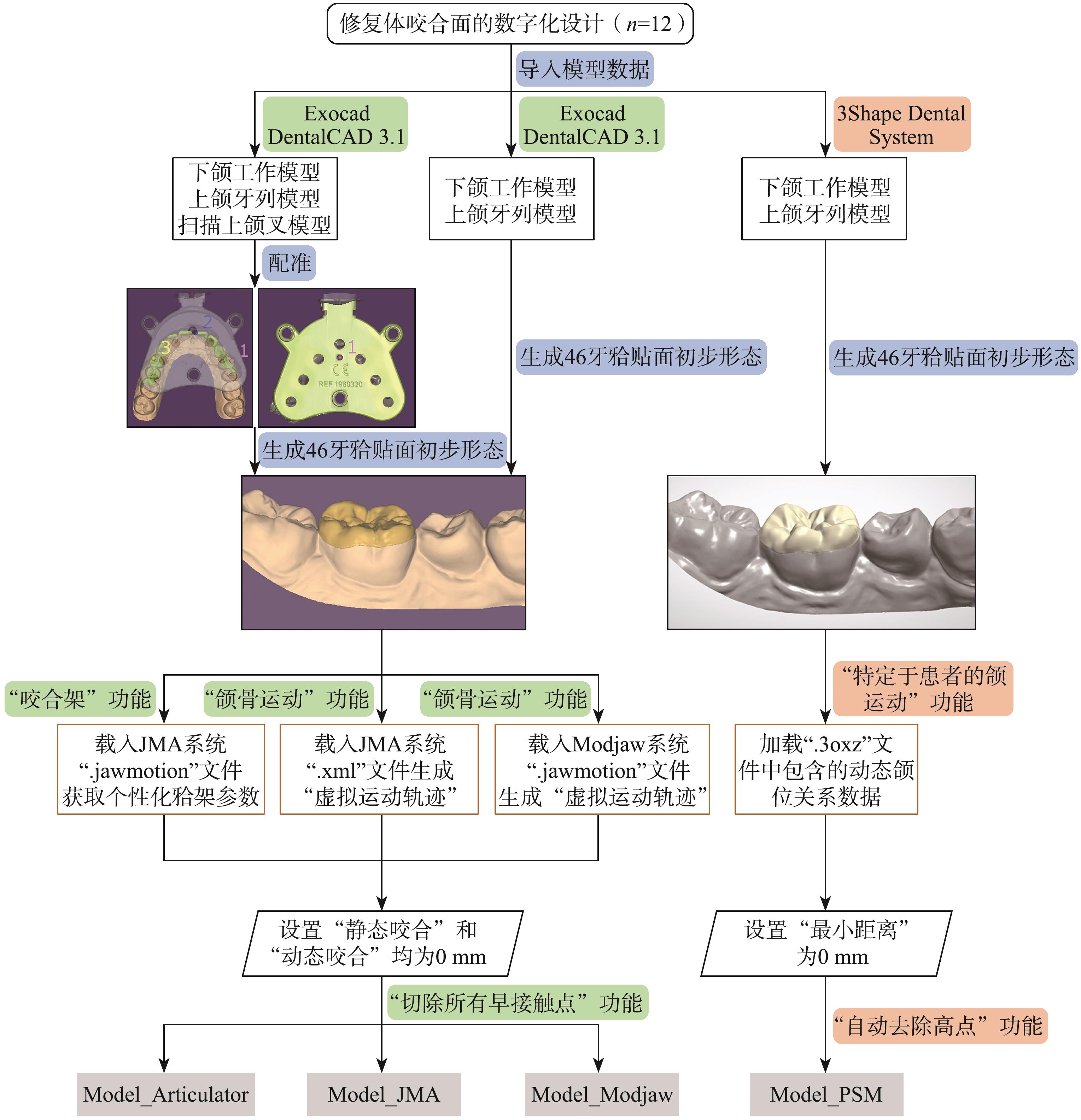
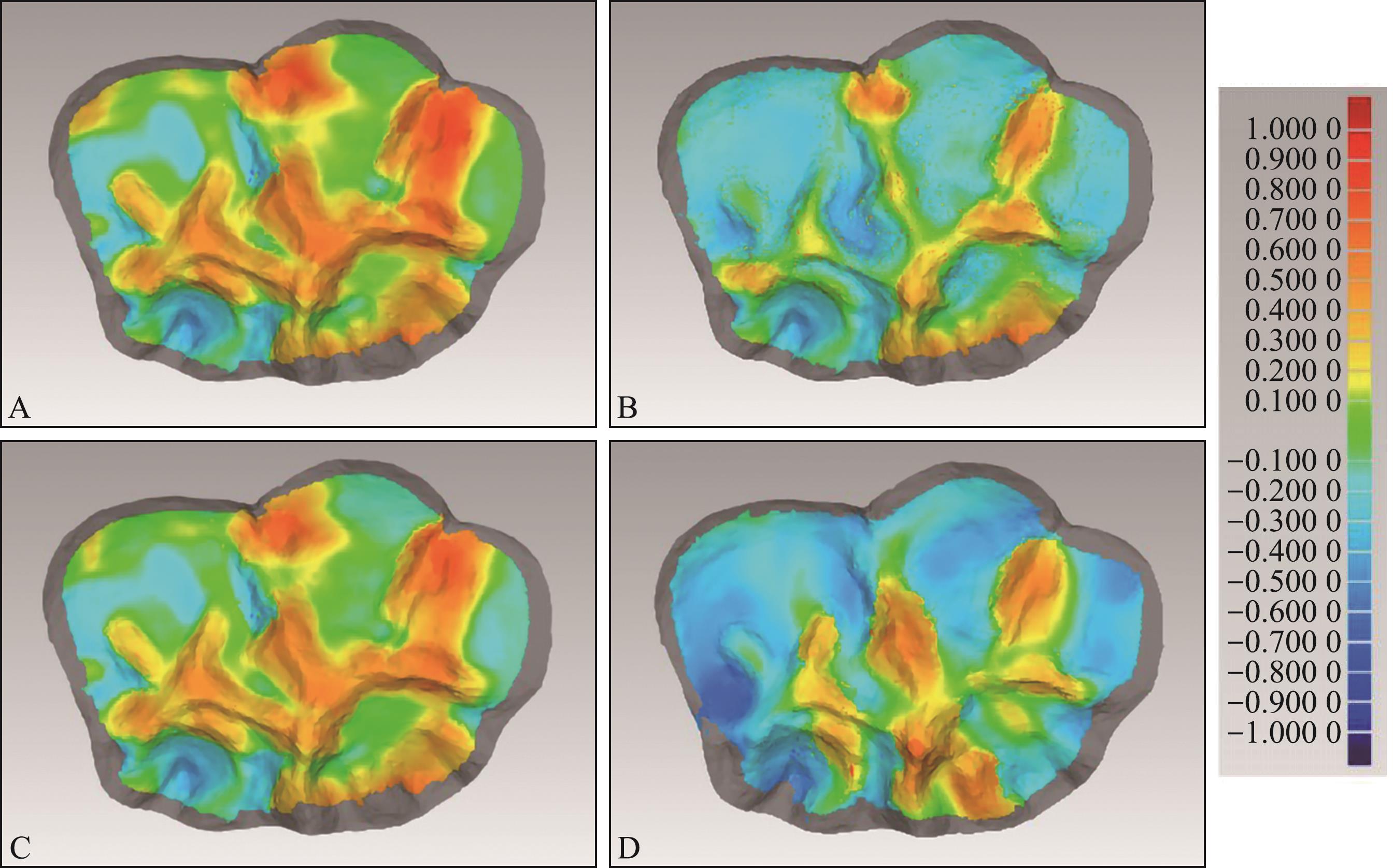
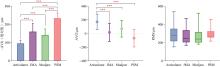
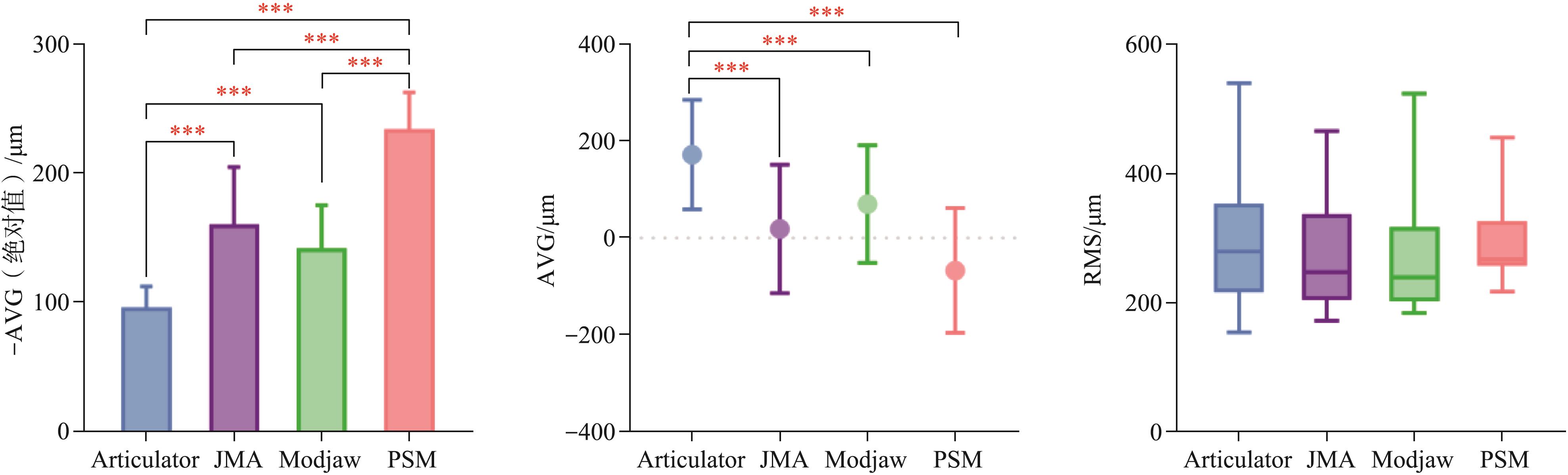
目的 通过数字化设计修复体咬合面的模型实验,比较基于轨迹的全可调𬌗架个性化参数、下颌运动轨迹和动态颌位关系指导设计下颌第一磨牙修复体咬合面的准确性。 方法 招募符合纳入标准的12例志愿者(男性4例,女性8例),平均年龄29.5岁。使用3Shape Trios 3口内扫描仪获取受试者上下颌三维牙列模型,并应用动态咬合记录功能采集其前伸、左右侧方运动的动态颌位关系,以及使用Zebris JMA Optic和ModjawTM下颌运动分析系统同样采集受试者前伸、左右侧方运动的下颌运动轨迹,并基于Zebris JMA Optic系统记录的下颌运动轨迹获取全可调𬌗架对应的个性化参数。使用逆向工程软件将原始模型中下颌第一磨牙按照𬌗贴面牙体预备标准进行虚拟预备,获取下颌工作模型。在修复设计软件中分别借助全可调𬌗架参数(Articulator组)、下颌运动轨迹(JMA组、Modjaw组)、动态颌位关系(PSM组)数字化设计下颌第一磨牙𬌗贴面的咬合面。通过逆向工程软件对不同方法设计的修复体咬合面形态与受试者原始天然牙咬合面形态进行偏差分析,采用多个测量学指标比较不同方法设计的修复体咬合面精度。 结果 Articulator组、JMA组、Modjaw组和PSM组的平均正偏差指标,组间差异无统计学意义(P>0.05);而平均负偏差、平均偏差及均方根指标,组间差异具有统计学意义(P<0.05)。Articulator组的平均负偏差(-96.2±15.8)μm大于JMA组(-160.1±44.4)μm、Modjaw组(-141.6±33.2)μm和PSM组(-233.6±28.5)μm;Articulator组的平均偏差(172.5±113.0)μm大于JMA组(19.2±132.6)μm、Modjaw组(70.3±121.3)μm和PSM组(-66.8±129.1)μm,差异具有统计学意义(P<0.05)。 结论 基于轨迹的全可调𬌗架个性化参数、下颌运动轨迹和动态颌位关系指导设计的下颌第一磨牙修复体咬合面形态与原始天然牙咬合面形态之间均存在一定差异。相较于利用全可调𬌗架参数,利用下颌运动轨迹及动态颌位关系设计修复体咬合面能更有效去除咬合干扰。
中图分类号:
| [1] | Walton TR, Layton DM. Mediotrusive occlusal contacts: best evidence consensus statement[J]. J Pros-thodont, 2021, 30(S1): 43-51. |
| [2] | 朱锦怡, 龚衍吉, 郑芳杰, 等. 咬合异常与颞下颌关节紊乱症的关系再思考[J]. 口腔医学, 2024, 44(1): 24-30. |
| Zhu JY, Gong YJ, Zheng FJ, et al. Reevaluation of the association between the malocclusion and temporomandibular disorders[J]. Stomatology, 2024, 44(1): 24-30. | |
| [3] | Di Fiore A, Meneghello R, Graiff L, et al. Full arch digital scanning systems performances for implant-supported fixed dental prostheses: a comparative study of 8 intraoral scanners[J]. J Prosthodont Res, 2019, 63(4): 396-403. |
| [4] | Cheng CW, Ye SY, Chien CH, et al. Randomized clinical trial of a conventional and a digital workflow for the fabrication of interim crowns: an eva-luation of treatment efficiency, fit, and the effect of clinician experience[J]. J Prosthet Dent, 2021, 125(1): 73-81. |
| [5] | 沈颉飞. 口腔修复诊疗中构建虚拟患者的机遇与挑战[J]. 华西口腔医学杂志, 2024, 42(1): 1-11. |
| Sheng JF. The chance and challenge of creating virtual patients in prosthodontics[J]. West China J Stomatol, 2024, 42(1): 1-11. | |
| [6] | Lepidi L, Galli M, Mastrangelo F, et al. Virtual arti-culators and virtual mounting procedures: where do we stand[J]. J Prosthodont, 2021, 30(1): 24-35. |
| [7] | Valenti M, Schmitz JH. A reverse digital workflow by using an interim restoration scan and patient-specific motion with an intraoral scanner[J]. J Prosthet Dent, 2021, 126(1): 19-23. |
| [8] | Tian SK, Dai N, Cheng XS, et al. Relative trajectory-driven virtual dynamic occlusal adjustment for dental restorations[J]. Med Biol Eng Comput, 2019, 57(1): 59-70. |
| [9] | 刘晓强, 谭建国. 一步一步做好微创修复的贴面牙体预备[J]. 中华口腔医学杂志, 2021, 56(3): 306-310. |
| Liu XQ, Tan JG. Tooth preparation of veneers in the minimally invasive restoration: step by step[J]. Chin J Stomatol, 2021, 56(3): 306-310. | |
| [10] | Williams WN, Lapointe LL, Thornby JI. Interdental thickness discrimination by normal subjects[J]. J Dent Res, 1974, 53(6): 1404-1407. |
| [11] | Tamaki K, Ishigaki S, Ogawa T, et al. Japan Pros-thodontic Society position paper on “occlusal discomfort syndrome”[J]. J Prosthodont Res, 2016, 60(3): 156-166. |
| [12] | 徐欣蕊, 余润平, 袁芸, 等. 基于下颌运动轨迹数据指导的数字化全冠咬合面精度评价[J]. 上海口腔医学, 2023, 32(1): 58-62. |
| Xu XR, Yu RP, Yuan Y, et al. Assessment of the reproducibility of occlusal morphology for digital full crown designed by mandibular trajectory data[J]. Shanghai J Stomatol, 2023, 32(1): 58-62. | |
| [13] | Kollmuss M, Jakob FM, Kirchner HG, et al. Comparison of biogenerically reconstructed and waxed-up complete occlusal surfaces with respect to the original tooth morphology[J]. Clin Oral Investig, 2013, 17(3): 851-857. |
| [14] | 马丽娅, 巢家瑞, 刘飞, 等. 基于下颌运动轨迹与虚拟𬌗架运动参数模拟调𬌗的对比研究[J]. 华西口腔医学杂志, 2023, 41(3): 254-259. |
| Ma LY, Chao JR, Liu F, et al. A comparative study based on the mandibular movement track and the movement parameters of the virtual articulator in simulating occlusal adjustment[J]. West China J Stomatol, 2023, 41(3): 254-259. | |
| [15] | Saini H, Wadell JN, Pullan AJ, et al. Automatically generating subject-specific functional tooth surfa-ces using virtual mastication[J]. Ann Biomed Eng, 2009, 37(8): 1646-1653. |
| [16] | 李琳琳, 陈虎, 李伟伟, 等. 正常𬌗力咬合状态下后牙移动的口内三维扫描测量和分析[J]. 中华口腔医学杂志, 2020, 55(10): 743-749. |
| Li LL, Chen H, Li WW, et al. Investigation of posterior teeth displacement under normal bite force by an intraoral scanner[J]. Chin J Stomatol, 2020, 55(10): 743-749. | |
| [17] | Li L, Chen H, Li WW, et al. Design of wear facets of mandibular first molar crowns by using patient-specific motion with an intraoral scanner: a clinical study[J]. J Prosthet Dent, 2023, 129(5): 710-717. |
| [18] | 李穗, 马雯洁, 王时敏, 等. 上前牙种植单冠修复体切导的数字化设计正确度[J]. 北京大学学报(医学版), 2024, 56(1): 81-87. |
| Li S, Ma WJ, Wang SM, et al. Trueness of different digital design methods for incisal guidance of maxillary anterior implant-supported single crowns[J]. J Peking Univ (Health Sci), 2024, 56(1): 81-87. | |
| [19] | Lee YC, Lee C, Shim JS, et al. Comparison between occlusal errors of single posterior crowns adjusted using patient specific motion or conventional me-thods[J]. Appl Sci, 2020, 10(24): 9140. |
| [20] | 谢培进, 刘伟才, 王灿, 等. 不同咬合记录方式制作后牙单冠的咬合适合性研究[J]. 口腔医学, 2021, 41(9): 810-815. |
| Xie PJ, Liu WC, Wang C, et al. Study on the occlusal suitability of posterior single crowns made by different occlusal recording methods[J]. Stomatology, 2021, 41(9): 810-815. | |
| [21] | Lin PT, Jiao Y, Zhao SJ, et al. Occlusion and disocclusion time changes in single unit crowns designed by functional generated path technique: a randomi-sed clinical trial[J]. Sci Rep, 2017, 7(1): 388. |
| [22] | Pröschel P, Morneburg T, Hugger A, et al. Articulator-related registration: a simple concept for minimizing eccentric occlusal errors in the articulator[J]. Int J Prosthodont, 2002, 15(3): 289-294. |
| [23] | Hsu MR, Driscoll CF, Romberg E, et al. Accuracy of dynamic virtual articulation: trueness and precision[J]. J Prosthodont, 2019, 28(4): 436-443. |
| [24] | Altarakemah Y, Akbar J, Akthar S, et al. Evaluation of a technique for reducing chairside occlusal adjustment of crowns[J]. J Prosthodont, 2021, 30(2): 183-188. |
| [25] | 隋华欣, 孙玉春, 王勇, 等. 基于光学定位运动跟踪技术的数字化𬌗架初步研究[J]. 口腔颌面修复学杂志, 2015, 16(1): 1-4. |
| Sui HX, Sun YC, Wang Y, et al. Preliminary study of digital articulator based on optical location trac-king technology[J]. Chin J Prosthodont, 2015, 16(1): 1-4. | |
| [26] | Fang JJ, Kuo TH. Tracked motion-based dental occlusion surface estimation for crown restoration[J]. Comput Aided Des, 2009, 41(4): 315-323. |
| [27] | Kijak E, Lietz-Kijak D, Frączak B, et al. Assessment of the TMJ dysfunction using the computeri-zed facebow analysis of selected parameters[J]. Bio-med Res Int, 2015, 2015: 508069. |
| [28] | 徐心雨, 吴灵, 宋凤岐, 等. 基于下颌运动轨迹的正颌外科术中下颌骨髁突定位方法及初步精度验证[J]. 北京大学学报(医学版), 2024, 56(1): 57-65. |
| Xu XY, Wu L, Song FQ, et al. Mandibular condyle localization in orthognathic surgery based on mandibular movement trajectory and its accuracy verification[J]. J Peking Univ (Health Sci), 2024, 56(1): 57-65. | |
| [29] | Ahlers MO, Bernhardt O, Jakstat HA, et al. Motion analysis of the mandible: guidelines for standardi-zed analysis of computer-assisted recording of condylar movements[J]. Int J Comput Dent, 2015, 18(3): 201-223. |
| [30] | 朱家奕, 王俊杰, 王宇轩, 等. 轻咬合和重咬合状态对下颌运动轨迹及虚拟预调𬌗的影响[J]. 中华口腔医学杂志, 2023, 58(1): 50-56. |
| Zhu JY, Wang JJ, Wang YX, et al. Study on mandi-bular movement trajectory and virtual occlusal pre‑ adjustment under light and heavy bite force[J]. Chin J Stomatol, 2023, 58(1): 50-56. |
| [1] | 吴承,胥一尘,万乾炳. 可切削聚合物渗透陶瓷在口腔修复中应用的研究进展[J]. 国际口腔医学杂志, 2024, 51(4): 441-449. |
| [2] | 钟雨欣, 于海洋. 计算机辅助设计和计算机辅助制造预成个性化同种异体骨块在种植骨增量手术中的应用进展[J]. 国际口腔医学杂志, 2024, 51(3): 319-325. |
| [3] | 和子慕, 李风兰. 数字化口腔定位支架在头颈部肿瘤放射治疗中的应用现状[J]. 国际口腔医学杂志, 2024, 51(1): 28-35. |
| [4] | 雒琪玥,柳叶语,罗依麟,满毅. 以正中关系为中心、面部美学及修复为导向的数字化无牙颌种植修复1例[J]. 国际口腔医学杂志, 2022, 49(4): 426-431. |
| [5] | 李如意,罗锋,万乾炳. 下颌运动实时记录系统的原理及其应用进展[J]. 国际口腔医学杂志, 2022, 49(2): 182-189. |
| [6] | 鲁雨晴,闵婕,陈昕,刘春煦,董博,岳莉,于海洋. 整体切削的聚醚醚酮可摘局部义齿即刻修复1例[J]. 国际口腔医学杂志, 2020, 47(3): 297-303. |
| [7] | 赵莹,杨柳,谢宇,张艳,魏溦,李江. 扫描对象对计算机辅助设计/计算机辅助制造钴铬烤瓷冠精确性影响的研究[J]. 国际口腔医学杂志, 2018, 45(6): 686-689. |
| [8] | 杜雪,瞿方,刘伟才. 三维虚拟牙科患者的建立及其在美学修复中的应用[J]. 国际口腔医学杂志, 2018, 45(6): 695-702. |
| [9] | 詹聃婷, 张帆, 郑立舸. 虚拟颌架的应用及研究进展[J]. 国际口腔医学杂志, 2018, 45(2): 228-232. |
| [10] | 万乾炳. 关于全锆冠的几个问题[J]. 国际口腔医学杂志, 2018, 45(1): 9-13. |
| [11] | 李燕玲, 王劲茗. 计算机辅助设计与制作钛支架在无牙颌患者种植固定修复中的应用现状[J]. 国际口腔医学杂志, 2017, 44(3): 344-349. |
| [12] | 陈春秀 文学锦. 计算机辅助设计和计算机辅助制造二氧化锆全瓷修复体的护理配合[J]. 国际口腔医学杂志, 2014, 41(2): 140-142. |
| [13] | 肖静1 滕伟2. 三维数字化扫描在口腔修复领域中的应用[J]. 国际口腔医学杂志, 2014, 41(1): 63-67. |
| [14] | 陈嵩. 无托槽隐形矫治技术——现在和将来[J]. 国际口腔医学杂志, 2013, 40(5): 561-564. |
| [15] | 王林虎综述 郭家平审校. CEREC 椅旁CAD/CAM 诊室技术25 年的研究进展[J]. 国际口腔医学杂志, 2012, 39(1): 124-127. |
|
||